
Yes—but the viral shorthand hides the real trade.
TurboFieldfare can keep its own measured physical footprint near 2 GB while generating text with the 26-billion-parameter Gemma 4 26B-A4B model. It achieves that by leaving roughly 12 GB of routed-expert weights on SSD and reading only the experts selected for the current token. The complete text-only installation is still about 14.3 GB, macOS may retain additional data in its file cache, and the first published 8 GB Mac measurements trade memory for latency.
That makes TurboFieldfare an impressive open-source inference experiment and a credible pilot for local-AI researchers with memory-constrained Apple Silicon Macs. It does not make version 0.3 a drop-in replacement for Ollama, MLX, or a production inference server.
This is a researched technical assessment of TurboFieldfare 0.3 and the upstream state observed on July 30, 2026. OpenSourceChoice did not have a compatible macOS 26 machine and did not independently reproduce the project's memory, speed, or output-quality results.
The verdict
Try TurboFieldfare when the constraint is specifically an 8 GB Apple Silicon Mac and the goal is to study or use Gemma 4 26B locally without forcing all quantized weights into unified memory. Its installer pins the source checkpoint, verifies the repacked model, and exposes the same runtime through a native app, CLI, Swift library, and experimental loopback API.
Do not adopt 0.3 for production, multi-user, or security-critical work. Upstream's own security policy says the project is not intended for those deployments. The current release is source-only, requires macOS 26 plus Xcode 26, supports one pinned text-only model, and comes from a repository created less than two weeks before this assessment.
If the Mac has enough memory for conventional MLX inference, use MLX as the performance baseline. If an 8 GB machine only needs a useful local assistant, compare a smaller Gemma 4 model through llama.cpp before accepting TurboFieldfare's longer time to first token and model-specific maintenance.
Why this matters now
The attention is real, even if attention is not evidence of production maturity.
- TurboFieldfare 0.3 was released on July 29, one day before this assessment.
- A July 29 Show HN submission had 681 points and 236 comments when checked on July 30, with discussion focused on SSD streaming, memory accounting, model quality, and the speed trade-off.
- The public repository rose above 1,100 stars on July 30 and received external issues and pull requests after its first public commit on July 19.
- Upstream shipped five source releases between July 20 and July 29 and merged runtime, installer, API, and long-context work on consecutive days.
Those signals are independent enough to establish current interest: a new tagged release, sustained repository work, and a large external technical discussion. They do not validate the benchmark. The benchmark remains project-produced, and several social summaries have already collapsed “about 2 GB physical footprint plus a 14.3 GB SSD installation” into the less accurate claim that a 26B model simply “needs 2 GB.”
Version 0.3 also lands at a useful moment for local inference. Google's own Gemma 4 memory table estimates about 14.4 GB to load the 26B A4B model at 4-bit precision through a conventional runtime. TurboFieldfare asks a different systems question: what if the inactive experts stay on fast local storage instead?
What the 2 GB number actually measures
Gemma 4 26B-A4B is a mixture-of-experts model. It contains about 25.2 billion parameters, but only about 3.8 billion are active for a token. Each of its 30 transformer layers has 128 routed experts; the router selects eight, while a shared expert remains resident.
TurboFieldfare reorganizes a pinned 4-bit MLX checkpoint into a custom .gturbo directory:
- a 1.35 GB common model file contains embeddings, attention weights, routers, shared experts, norms, and related resident data;
- roughly 12.0 GiB of routed-expert files remain on SSD;
- a 4K FP16 KV cache uses about 305 MiB;
- reusable scratch buffers and selected expert slots consume additional memory;
- macOS maintains a separate, dynamic file cache outside the app-owned budget.
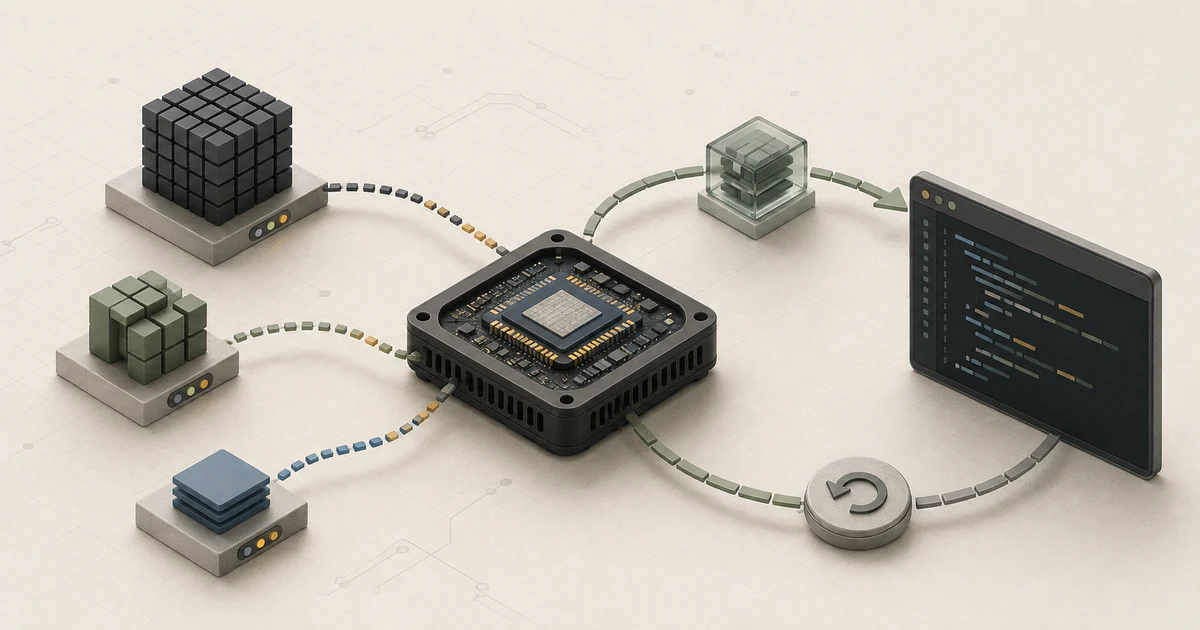
At decode time, Metal calculates the router result. The CPU reads the selected expert IDs, checks a 16-slot per-layer cache, fills misses with bounded parallel pread calls, and overlaps those reads with resident GPU work. The runtime therefore avoids loading the complete quantized model into unified memory.
The important distinction is:
| Resource | Approximate amount | Where it lives |
|---|---|---|
| Installed text-only model | 14.3 GB | SSD |
| Common model file | 1.35 GB | Read-only mapping available to Metal |
| 4K KV cache | 305 MiB | Unified memory |
| Project-reported physical footprint | 1.9–2.1 GB | Process footprint during measured runs |
| Routed experts not currently selected | Most of the 12.0 GiB expert set | SSD, with a dynamic OS file cache |
“2 GB” is therefore a working-set claim, not a model-size claim. It also is not the total memory used by macOS, the foreground app, build tools, other applications, and the file cache.
This architecture is not magic compression. It is a deliberate exchange of memory bandwidth for storage I/O and coordination latency. Apple researchers previously explored a related family of techniques in LLM in a Flash: keep only a useful working set in memory and stream the rest from flash. TurboFieldfare applies that idea to Gemma 4's routed experts with a custom Swift and Metal implementation.
What version 0.3 changes
Release 0.3 accelerates long-context prefill on Apple10 GPUs. According to the release notes, a new TensorOps path processes grouped-query attention heads together and improved one 32K full-runtime prefill measurement from 491.09 seconds to 204.29 seconds on the project's newer validation hardware.
That result needs three boundaries:
- It is an upstream measurement, not an independent benchmark.
- The new path targets Apple10 GPUs; earlier GPU families retain the previous causal-tiled path.
- The current system-design document still describes complete app and CLI acceptance evidence through 4K context, even though component checks and the 0.3 prefill work reach longer contexts.
The release does not add a packaged desktop installer. It contains source archives only. It does not add Windows, Linux, Intel Mac, older macOS, model switching, multimodal input, remote serving, or production support.
The benchmark is promising, but narrow
Upstream publishes unusually detailed benchmark caveats. That is a positive sign, but it does not turn one project's measurements into independent evidence.
| Host and path | Project-reported decode | Memory evidence | Important caveat |
|---|---|---|---|
| 8 GB M2 MacBook Air, TurboFieldfare | 5.10–6.30 tok/s | About 1.8–2.0 GiB footprint in four measured rows | Each row ran once; file cache was warm but uncontrolled |
| 24 GB M5 Pro, TurboFieldfare | 31–35 tok/s | About 2.1 GiB footprint | Medians of three fresh-process measurements after warmup |
| 24 GB M5 Pro, MLX | 76.33–82.07 tok/s | 8.27–9.79 GB RSS and 14.66–15.31 GB GPU allocation | Different memory counters; not a direct ratio |
On the 8 GB M2, time to first token ranged from roughly eight seconds for a six-token prompt to almost 38 seconds for a 1,017-token prompt. That matters more than decode speed for interactive use. A 5–6 token-per-second response can feel acceptable once it starts, while a long prefill delay can make document work frustrating.
The M5 comparison exposes the actual bargain. TurboFieldfare used far less app memory than MLX but delivered less than half MLX's decode throughput on the same host. If the machine can hold the model comfortably, upstream itself recommends starting with MLX.
The published evidence does not yet answer:
- sustained performance over hours of mixed prompts;
- battery draw, thermals, and performance while normal desktop applications remain open;
- p95 time to first token under file-cache pressure;
- output quality across a representative task suite;
- behavior on M1, M3, and M4 systems under one frozen protocol;
- reliability at the advertised 16K, 32K, and 64K application settings;
- performance after the SSD and OS are placed under competing I/O load.
These are not reasons to dismiss the result. They are the next measurements required before a clever prototype becomes a dependable tool.
What users get—and what they do not
TurboFieldfare 0.3 exposes six Swift products:
- a reusable inference library;
- a native Mac application;
- a local decode service used by that application;
- a command-line client;
- a streaming model repacker and verifier;
- an experimental OpenAI-compatible local server.
The Mac app is currently closer to a polished experiment console than a full local-AI workspace. Its released interface handles isolated prompt-and-response runs. Persistent multi-turn chat and document attachments exist in an open pull request, not in 0.3.
The loopback server is more flexible. It accepts Chat Completions requests, streams responses, reuses one verified prompt prefix, and can return function-tool calls for a client to authorize and execute. Its API remains deliberately narrow:
- one model and one generated choice;
- one generation at a time, with a small queue;
- no Responses API;
- no embeddings, batching, structured output, log probabilities, or remote model switching;
- no image, audio, or video input;
- no remote authentication or TLS.
Gemma 4 26B is natively multimodal, but TurboFieldfare omits the vision tower and installs a text-only package. The official model supports up to 256K context; TurboFieldfare's application offers up to 64K, with the strongest complete public acceptance evidence still much smaller.
This specialization is the source of the memory result. It is also the main portability limit.
Installation is a developer workflow
The official path is:
- use an Apple Silicon Mac;
- install macOS 26, Xcode 26, and Swift 6.2 or newer;
- clone the repository;
- compile the complete Swift package in release mode;
- download about 15 GB from Hugging Face;
- let the installer repack and verify the 14.3 GB text-only model;
- run the app, CLI, or loopback server from the build output.
The project is ARM64-only. An open issue tracks possible macOS 15 fallback support, which confirms that older macOS versions are not a current installation path.
There is no official Homebrew formula, Mac App Store package, notarized application download, Docker image, Windows build, or Linux build. Version 0.3 has no release assets beyond GitHub's source archives.
That setup is reasonable for an inference-engine researcher. It is too much to call a mainstream “one-click local AI app.”
Privacy and security boundaries
After installation, the core inference design operates locally: prompts are tokenized on the Mac, selected weights are read from local storage, and Metal performs generation. The initial build retrieves Swift dependencies, and the model installer makes bounded requests to a pinned Hugging Face revision.
The model package has better integrity controls than many experiments. The installer records a fixed source revision, writes a manifest, hashes the common files, verifies routed-expert files, and atomically promotes a completed installation. Package dependencies are locked in Package.resolved.
The remaining boundaries matter:
- the local HTTP server binds to
127.0.0.1without authentication or TLS, and upstream says not to expose it through a proxy or tunnel; - a client, not TurboFieldfare, authorizes and executes returned tool calls;
- source builds depend on the integrity of the checked-out commit, Swift packages, Xcode toolchain, and downloaded model;
- there is no signed application binary to verify or centrally deploy;
- generated text can be wrong, outdated, biased, or unsafe, as Google's model card warns;
- local processing reduces data disclosure, but it does not add access control, audit logging, content policy, or output validation.
TurboFieldfare has a private vulnerability-reporting path and no published GitHub security advisories were visible on July 30. That is not evidence that no vulnerabilities exist. The repository is young, and its security policy explicitly limits support to the latest main branch rather than promising fixes for tagged releases.
For sensitive data, test the release with a network monitor after installation, disable any external tools in the client, keep the server on loopback, and use operating-system controls to restrict which users can access the model process and prompts.
Maturity and bus-factor risk
The repository was created on July 17, and its public history starts on July 19. At the assessment cutoff, all 12 commits on main came from one maintainer. An external contributor had opened a substantial chat-history pull request, but it was not merged.
That concentration creates a bus-factor of one for the released code. Five tags in nine days demonstrate momentum, not compatibility history. Rapid releases also increase the chance that model layout, runtime controls, benchmark protocol, and build requirements will change together.
Positive engineering signals include:
- a macOS CI build and serial test workflow;
- extensive reference tests and benchmark documentation;
- pinned model and dependency revisions;
- a security policy with private reporting;
- explicit documentation of failed experiments and measurement limitations;
- active responses to feature requests.
Missing maturity signals include:
- multiple maintainers with merged ownership;
- a compatibility policy for 0.x releases;
- signed and notarized binaries;
- independent performance or security review;
- long-running release support;
- production incident and upgrade experience.
The safest reading is “well-documented research runtime,” which is also how upstream describes it.
License, cost, and lock-in
TurboFieldfare's source and documentation use Apache License 2.0. Google also publishes Gemma 4 under Apache 2.0, and the pinned MLX community quantization identifies the upstream checkpoint and revision. Commercial use is permitted, subject to the license, attribution, notice, patent, and exact dependency-distribution obligations.
The software has no subscription cost. The real cost is:
- an Apple Silicon Mac and current Apple developer toolchain;
- 15 GB of initial transfer and 14.3 GB of persistent storage per installation;
- build, upgrade, and model-verification time;
- slower prompt processing on lower-end hardware;
- validation of model quality for the intended task;
- maintaining a source-only, single-model runtime.
License lock-in is low, but technical lock-in is high. The custom .gturbo layout, Swift code, Metal kernels, macOS 26 APIs, and one pinned Gemma checkpoint are intentionally coupled. The original weights remain available in standard ecosystems, so data is not trapped; the operating path is.
Alternatives to evaluate in parallel
| Option | Better fit | Main trade-off |
|---|---|---|
| MLX / MLX-LM with Gemma 4 26B | Apple Silicon machines with enough unified memory and teams that want faster, more general inference | The full 4-bit model does not fit comfortably on an 8 GB Mac |
| llama.cpp with an official Gemma 4 QAT GGUF | Cross-platform local inference, a mature ecosystem, broad client support, and portable model files | Conventional 26B Q4 loading needs roughly 14.4 GB before runtime and context overhead |
| Gemma 4 E4B or E2B in a conventional runtime | 8 GB machines where responsiveness, portability, and operational simplicity matter more than 26B model quality | Smaller models have lower capability and need workload-specific quality testing |
| A hosted model API | Multi-user products, autoscaling, managed availability, and no local build burden | Recurring cost, network dependency, provider data boundary, and vendor lock-in |
The most useful comparison is not “TurboFieldfare versus the cloud.” It is TurboFieldfare 26B versus the best smaller local model that meets the same task-quality threshold. A smaller model that starts in two seconds and answers correctly often beats a larger model that starts in 30 seconds.
A practical evaluation plan
1. Freeze the complete test target
Record TurboFieldfare tag 0.3, full commit, macOS build, Xcode and Swift versions, Mac model, memory capacity, SSD free space, and the generated model-manifest hash. Do not compare a future main checkout with the 0.3 article claim.
2. Build three baselines
Use the same prompt suite with:
- TurboFieldfare and its pinned Gemma 4 26B checkpoint;
- the same 26B checkpoint in MLX on a machine that can hold it;
- a smaller Gemma 4 model in llama.cpp on the 8 GB machine.
Include short chat, a 1K prompt, the longest real document, and at least one task with an objectively scored answer.
3. Measure the user experience, not one token rate
Record:
- model-load time;
- p50 and p95 time to first token;
- decode tokens per second;
- peak process footprint and system memory pressure;
- bytes read from storage per generated token;
- battery drain and thermal state;
- output correctness and refusal rate;
- failure rate over at least 100 sequential requests.
Run cold-cache and warm-cache blocks. Keep background applications representative of normal use.
4. Test privacy and execution boundaries
After the model is installed, capture network traffic during app, CLI, and server use. The acceptance criterion should be zero unexpected outbound requests. Keep the server on loopback, verify that another device cannot connect, and require confirmation before any client executes a model-produced tool call.
5. Exercise failure and recovery
Interrupt and resume the model download. Verify the installed package. Corrupt a copy of one expert file and confirm that validation rejects it. Upgrade from one tag and roll back to the prior tag without overwriting the known-good model directory.
6. Set adoption gates
A bounded pilot should pass all of these:
- no unexplained network request after installation;
- no sustained memory-pressure warning during representative work;
- p95 time to first token below the team's interactive threshold;
- task accuracy at least equal to the chosen smaller-model baseline;
- repeatable builds from a pinned tag and dependency lock;
- a tested rollback path;
- no remote exposure of the unauthenticated server;
- an owner willing to track every upstream 0.x release.
Failure on any critical gate should send the workflow back to the smaller-model or MLX baseline.
Who should try it—and who should wait
Good candidates: local-inference researchers, Swift and Metal engineers, open-source contributors, and technically comfortable owners of 8 GB M-series Macs who specifically want to explore Gemma 4 26B.
Use only for a bounded internal pilot: teams evaluating memory-constrained offline summarization, classification, or private drafting on managed Macs. Keep prompts non-critical, pin every artifact, and measure task quality.
Wait: nontechnical users expecting a signed desktop installer, Windows or Linux users, organizations on older macOS versions, multi-user services, regulated environments, and any team that needs supported production inference.
TurboFieldfare proves that “the model does not fit in RAM” is not always the end of the conversation. Its bigger contribution is architectural: a mixture-of-experts model can exchange memory residency for carefully scheduled SSD reads and remain usable on hardware that a conventional runtime excludes.
The 2 GB result is credible enough to investigate and too narrow to generalize. Treat 0.3 as a strong research release, compare it against a smaller local model and MLX, and let measured time to first token, output quality, and operational repeatability—not the headline—decide.
Sources
Primary sources were accessed on July 30, 2026 unless another date is stated.
- TurboFieldfare 0.3 source and README — Andrey Mikhaylov; current requirements, installation, architecture summary, interfaces, and scope.
- TurboFieldfare 0.3 release notes — released July 29, 2026; Apple10 prefill changes, validation, and source-only packaging.
- TurboFieldfare benchmarks — project-produced M2, M5, and MLX measurements plus methodology limitations.
- TurboFieldfare system design — resident and streamed resources, model layout, verification, cache behavior, supported scope, and acceptance boundary.
- Local OpenAI-compatible server — loopback binding, API surface, queueing, prompt reuse, tool-call boundary, and unsupported features.
- TurboFieldfare security policy — support scope, production warning, and private vulnerability reporting.
- TurboFieldfare Package.swift — macOS 26, Swift 6.2, package products, dependencies, and test targets.
- TurboFieldfare third-party notices — pinned model revision, Apache licensing, and resolved dependency review dated July 15, 2026.
- TurboFieldfare CI workflow — release build, serial test, and Markdown-link checks on macOS 26.
- macOS 15 fallback issue — opened July 29, 2026; confirms older-macOS support remains under investigation.
- Multi-turn chat issue and chat-history pull request — current Mac-app limitation and unmerged work observed July 30, 2026.
- Gemma 4 model overview — Google; updated July 8, 2026; official parameter, memory, quantization, and local-runtime guidance.
- Gemma 4 model card — Google DeepMind; updated July 16, 2026; architecture, capabilities, Apache 2.0 license, risks, and limitations.
- Gemma 4 technical report — Google DeepMind; submitted July 2, 2026; original architecture and evaluation research.
- Pinned MLX Gemma 4 26B 4-bit checkpoint — source model revision used by TurboFieldfare.
- LLM in a Flash — Alizadeh et al., Apple; flash-storage-assisted inference research used as architectural context.
Discovery and interest signal, not used as sole evidence for technical claims:
- Show HN: Open-source engine running Gemma 4 26B in 2 GB RAM — Hacker News discussion submitted July 29, 2026; community questions and author responses about memory, I/O, performance, and platform limits.
Build a stack for this use case.
Answer nine practical questions and compare three transparent architectures with costs, free limits, lock-in, and migration paths.
Build my stack