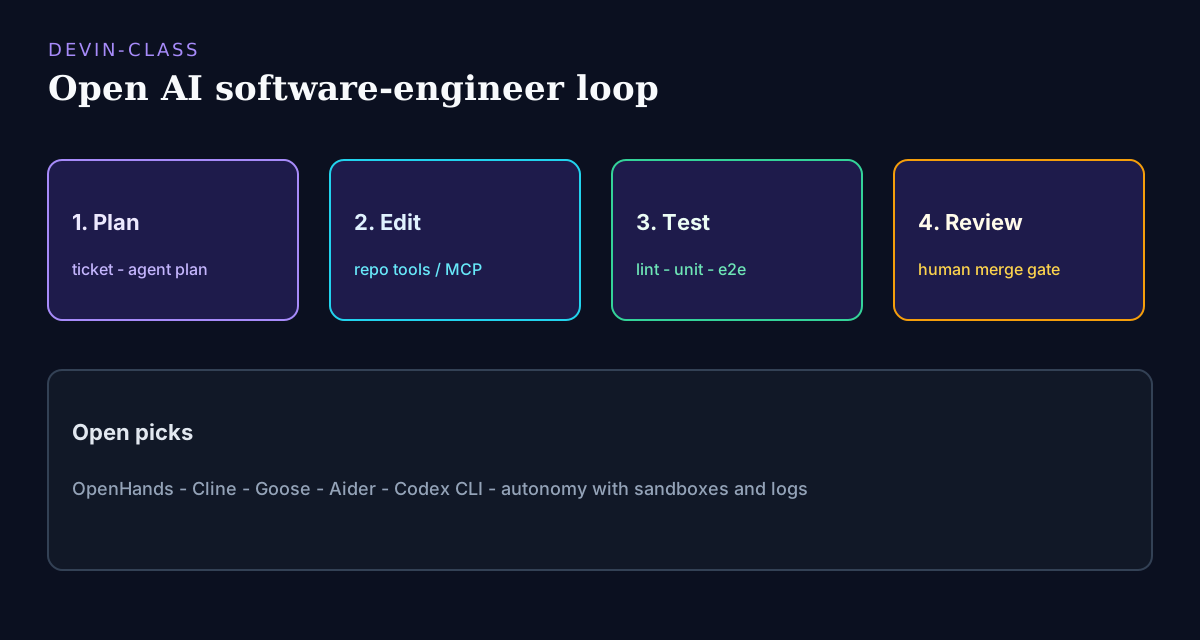
Devin popularized the “AI software engineer” narrative: an agent that plans, edits repositories, runs tests, and opens PRs with less hand-holding than autocomplete. The demos are compelling precisely because they compress a whole workflow—ticket intake, planning, coding, testing, review—into one product surface. Open-source alternatives do not clone Cognition’s product; they give you supervised autonomy with tools you can audit, sandbox, and route to any model.
Teams look beyond Devin for predictable reasons: source code that cannot leave the perimeter, usage-based agent pricing that is hard to budget, the need to inspect exactly what an agent executed before it touches production, or simply wanting to swap models per task instead of accepting a vendor’s routing. Each of those motivations maps to a different open project, so name your reason before you shortlist.
The winning FOSS pattern is a stack, not a single binary: an agent runtime (OpenHands, Goose, Cline, Aider, Codex CLI) + clear permissions + optional MCP plugins for git, docs, and browsers. Autonomy without guardrails is a liability, not a feature—and the open ecosystem forces you to make the guardrails explicit, which is usually an improvement over trusting a black box.
Key takeaways
- OpenHands is the strongest open cousin for longer autonomous coding tasks.
- Cline/Continue cover interactive IDE agency; Aider/Codex CLI cover terminal loops.
- Goose + MCP is the portable “plugins for the engineer agent” path.
- Measure on one real ticket with tests—not a greenfield toy repo.
- Human review gates stay mandatory for production code, whatever the demo implies.
- Budget model tokens explicitly: autonomous loops can cost more than a Devin seat if unmetered.
Clarify what “Devin alternative” means
“Devin alternative” hides several different jobs. The right open-source pick depends on which of these you actually need, because they are different product classes with different supervision models:
- Multi-step coding tasks with tool use (shell, tests, browser)—the full autonomous-ticket loop.
- Less babysitting than chat-in-IDE, but more supervision than “fire and forget”—interactive agency.
- Private or self-hosted operation when code cannot leave the perimeter.
- Cost control versus usage-based autonomous agent pricing.
- An inspectable audit trail: what did the agent run, read, and change—and can you replay it?
Quick comparison
| Project | Autonomy level | Best for | Notes |
|---|---|---|---|
| OpenHands | High (supervised) | Longer engineering tasks | Top Devin-class FOSS pick; self-hostable with sandboxed execution |
| Cline | Medium–high | Interactive IDE agents | Visible tool loops with approval gates; closest to daily-driver agency |
| Goose | Medium–high | Local agent + MCP tools | Plugin-portable; the extensible path when tools matter as much as the agent |
| Aider | Medium | Git-native CLI edits | Fast proof of value; diffs and commits as first-class output |
| OpenAI Codex CLI | Medium–high | Terminal coding agent | Official OSS baseline; useful benchmark for the whole shortlist |
| Continue | Medium | BYO-model IDE help | Less “engineer,” more assistant—pair it with a heavier agent |
| Zed | Lower (editor-first) | Fast AI editor workflows | Different product class; relevant only if the editor is the real question |
OpenHands
OpenHands
Open in catalogOpen autonomous coding agent oriented around multi-step engineering work—the closest catalog answer when people say “open-source Devin.” Strengths: sandboxed execution environments, a genuine plan-edit-test loop rather than single-shot edits, self-hosting for private code, and model-agnostic routing. Limits: setup and operations are on you, long tasks can consume serious tokens, and output quality still tracks the underlying model. Choose it when you want to run real autonomy experiments you can inspect end-to-end—and keep a human in the loop for merges and production changes.
- Best for
- Teams prototyping AI software-engineer workflows they can inspect or self-host.
- Deployment
- Self-hosted / local.
- Pricing
- Open-source; model and infra costs separate.
- Unique
- Best headline Devin alternative in the catalog.
Cline + Goose + Aider + Codex CLI
 Cline
Cline
Open in catalogIDE-centric agent with visible plans and tool calls. Strengths: every step is shown and approvable before it runs, strong MCP integration, and provider-agnostic models—often the practical daily driver even when Devin demos look more autonomous. Limits: it lives in your editor session rather than running tickets unattended, and heavy tasks burn tokens quickly. Choose it when you want Devin-style agency with a review checkpoint at every step, not delegation.
- Best for
- Developers who want agency inside the editor with oversight.
- Deployment
- Editor extension.
- Pricing
- Open-source; models separate.
- Unique
- Best interactive path from Devin hype to real PRs.
Goose
Open in catalogLocal agent runtime with a strong MCP story—attach repo, docs, and browser tools without a proprietary plugin store. Strengths: tool portability across clients, local-first operation, and an extension model you control. Limits: it is a runtime you assemble, not a polished product, and the experience depends on which MCP servers you wire in. Choose it when the tools around the agent matter as much as the agent itself, or when you expect to swap agents later and want your plugins to survive the move.
- Best for
- Builders who want Devin-like tools under their control.
- Deployment
- Local.
- Pricing
- Open-source.
- Unique
- Best “plugins for the AI engineer” bridge.
Aider
Open in catalogTerminal-first repo editing with git habits: diffs, commits, and repo maps as the primary interface. Strengths: the fastest measurable value on a real repository, output that reviews like a normal PR, and minimal setup. Limits: it is a pairing tool rather than an autonomous engineer—you drive the session, and there is no browser or long-horizon planning. Choose it when Devin for you means “ship reviewed commits faster,” not a GUI agent product.
- Best for
- Engineers who prefer CLI + diffs.
- Deployment
- CLI.
- Pricing
- Open-source.
- Unique
- Fastest measurable value on a real repository.
OpenAI Codex CLI
Open in catalogOpen coding agent/CLI from OpenAI—useful as an official OSS baseline in the same shortlist as Devin peers. Strengths: an inspectable, actively maintained reference implementation with configurable approval modes and sandboxing. Limits: it is terminal-scoped rather than a full ticket-to-PR platform, and best results assume OpenAI models even though the code is open. Choose it when you want a credible, low-commitment benchmark to compare OpenHands, Cline, and Aider against on your own tickets.
- Best for
- Teams comparing autonomous coding agents with an inspectable CLI.
- Deployment
- CLI.
- Pricing
- Open-source CLI; models/APIs may cost money.
- Unique
- Strong peer listing next to OpenHands/Cline.
Selection criteria
Score candidates against the constraints that decide long-term fit—not the demo. An agent that wins a greenfield demo but fails on sandboxing or cost will be abandoned within a month:
- Can the agent run fully inside your perimeter, with no code or context leaving by default?
- Is every tool call logged and replayable for incident review?
- Can you gate destructive actions (push, deploy, delete) behind human approval?
- How does it handle a real ticket on your monorepo—including flaky tests and missing docs?
- Is model routing yours to control, per task or per repository?
- What does a week of realistic usage cost in tokens versus a Devin seat?
Operating model (don’t skip)
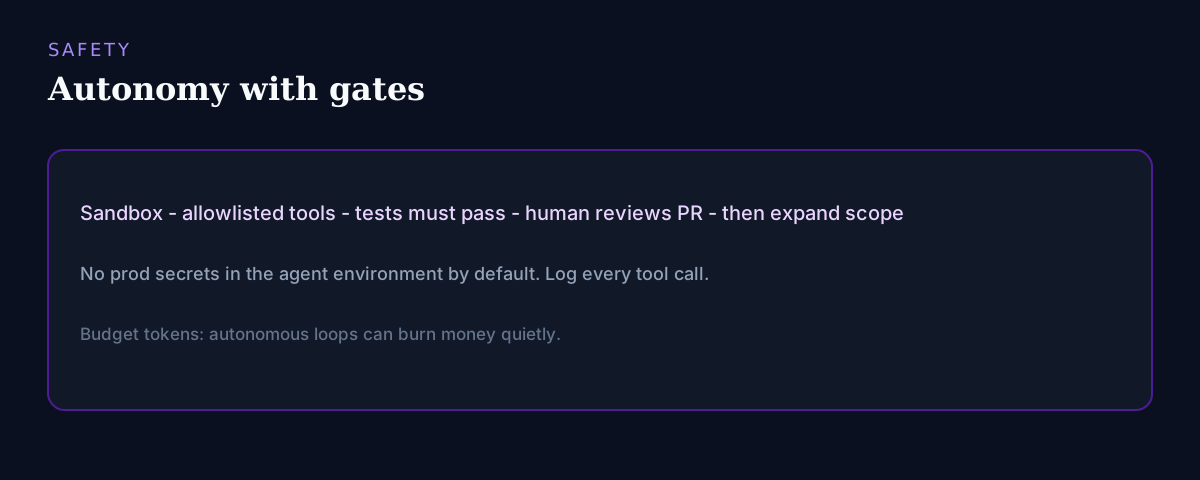
- Sandbox the agent (no prod credentials by default).
- Require tests/lint before merge proposals.
- Allowlist MCP/tools; expand power gradually.
- Log tool calls for incident review.
- Budget tokens—autonomous loops can burn money quietly.
Migration playbook
Do not try to replace Devin across the team in one step. A one-week pilot on a real ticket tells you more than any benchmark:
- Day 1: pick one real, bounded ticket with existing tests; set up OpenHands (or your top candidate) in a sandbox with read-only credentials.
- Day 2: let the agent attempt the ticket end-to-end; save the full transcript and every tool call.
- Day 3: review the proposed diff like a normal PR—count how many review comments a human colleague would have earned for the same change.
- Day 4: run the same ticket through a lighter tool (Aider or Cline) and compare time, tokens, and diff quality.
- Day 5: total the token spend, decide which autonomy level actually paid off, and write the allowlist/sandbox policy before onboarding anyone else.
- Only expand agent permissions after two clean weeks—power should follow evidence, not enthusiasm.
What still favors paid Devin
Honesty makes migrations succeed. Devin retains real advantages: the onboarding is near-zero, the planning-execution loop is tuned end-to-end by one vendor, and the product handles environment setup, browsing, and long-horizon tasks without you assembling anything. If your team’s bottleneck is engineering time to operate infrastructure, a hosted agent can genuinely be cheaper than a self-run stack. The open path wins when privacy is non-negotiable, when usage volume makes per-task pricing painful, or when you need audit trails and model control that a closed product cannot offer.
Frequently asked questions
- Is there a true open-source Devin?
- Not as a drop-in Cognition twin. OpenHands plus peer agents (Cline, Goose, Aider, Codex CLI) cover the same workflow class with more transparency and ops ownership. The trade is assembly and operations in exchange for auditability, self-hosting, and model choice—usually a good trade for teams with privacy or cost constraints.
- Devin vs Claude Code vs Codex vs Cursor?
- Devin markets fully autonomous engineering; Claude Code and Codex are agent/CLI oriented with human checkpoints; Cursor is an AI editor. They are different supervision models, not interchangeable products. Shortlist by how much autonomy you actually want and where you want to review—inline, per step, or per PR.
- Can I self-host a Devin alternative?
- Yes—OpenHands and Goose-class setups run entirely on your infrastructure, and Aider/Codex CLI run locally with any API or local model. You own upgrades, sandboxes, and model routing, which is exactly what regulated teams need and exactly what adds operational work.
- Should agents browse the web while coding?
- Sometimes—for documentation lookups it is genuinely useful. Treat browser tools like Operator-class stacks: allowlist domains, start read-only, and never combine browsing with production credentials in the same session. See the browser agents guide for the full safety model.
- What does an open Devin stack actually cost?
- The software is free; the models and infrastructure are not. A heavy autonomous loop can consume more in tokens than a hosted seat, while a supervised Aider/Cline workflow usually costs far less. Meter your pilot week and decide on numbers, not vibes.
Conclusion
Capture Devin demand with honesty: pick OpenHands for autonomy experiments you can audit, Cline/Aider/Codex CLI for daily engineering loops, and MCP for portable tools that outlive any single agent. The teams that succeed treat autonomy as a privilege the agent earns—one real ticket, with tests and a human review gate, before any expansion of permissions. Prove one ticket end-to-end, write down the sandbox policy, and only then scale the stack to the rest of the team. That discipline, more than any single tool choice, is what separates working agent adoption from expensive demos.
Build a stack for this use case.
Answer nine practical questions and compare three transparent architectures with costs, free limits, lock-in, and migration paths.
Build my stack