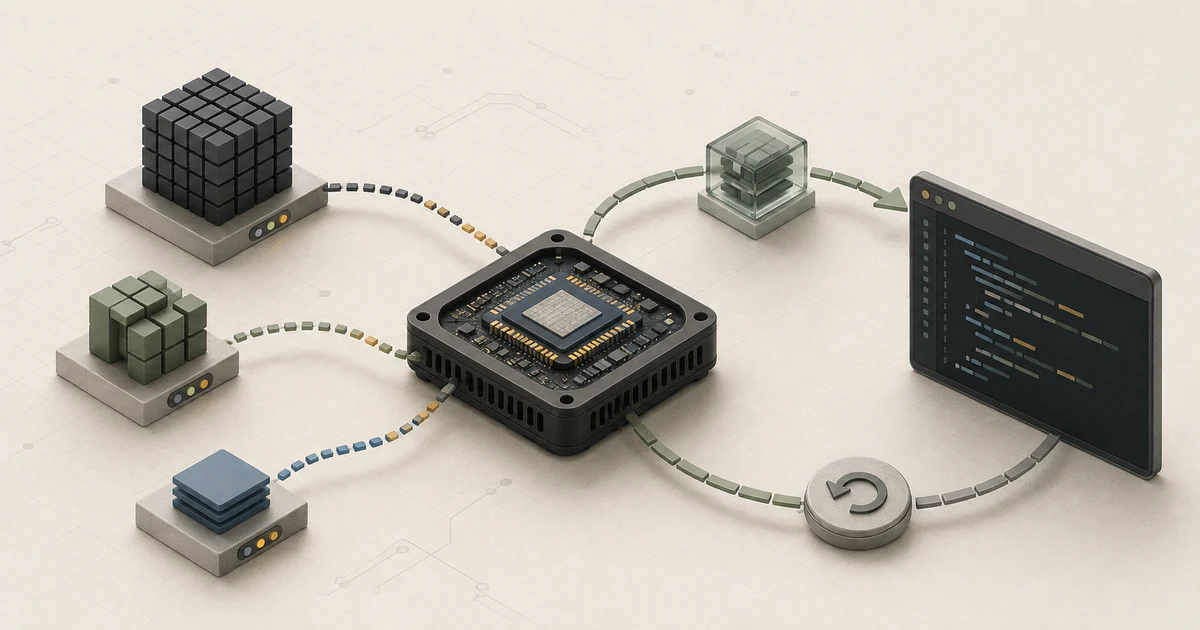

oMLX 0.6.2 turns an Apple Silicon Mac into a multi-model inference server with OpenAI- and Anthropic-compatible APIs, continuous batching, model lifecycle controls, and a tiered prefix cache. That is enough to justify a serious pilot for a Mac-only team. It is not enough to justify an unattended production upgrade.
The project released 0.6.0, 0.6.1, and 0.6.2 on three consecutive days from August 16 to 18, followed by a 0.6.3 release candidate on August 19. The candidate is explicitly labeled 0.6.3rc1, yet GitHub currently marks it as the latest release and the Homebrew formula on the default branch points to it. That packaging state makes version pinning part of the architecture, not routine housekeeping.
OpenSourceChoice verdict: evaluate oMLX 0.6.2 when Apple Silicon is already the target, multiple local clients need a shared API, and model loading or repeated long prompts create measurable waste. Keep the server on localhost or a protected private network, set an API key, cap or disable the SSD cache for sensitive workloads, and preserve a simpler MLX-LM, llama.cpp, or Ollama rollback. Do not let a floating Homebrew update choose the release line for production.
This is a researched technical analysis of the tagged source, release notes, packaging, tests, open issues, and official alternatives. OpenSourceChoice did not install oMLX on a Mac or reproduce the maintainers' benchmarks, so performance claims below remain project-reported until a workload-specific test confirms them.
Executive decision brief
| Decision factor | Evidence and consequence |
|---|---|
| Latest final release | oMLX 0.6.2, released August 18, 2026 |
| Newer upstream build | 0.6.3rc1, released August 19; a release candidate that GitHub currently presents as latest |
| Why evaluate | One Apple Silicon host can serve several MLX models and clients through familiar APIs, with batching, memory-aware loading, and reusable prompt caches |
| What 0.6.2 changes | Adds ANE/GPU split tuning and M5 NAX support, fixes a TQ plus MTP crash, restores exact FP32 GDN cache snapshots, and includes memory, cluster, and MCP fixes |
| Main risk | Rapid release churn combined with workload-specific regressions and a package path that can move onto a release candidate |
| Hidden operating cost | Unified-memory headroom, model storage, SSD cache growth and wear, process supervision, authentication, observability, and regression testing |
| Privacy boundary | Ordinary local inference can remain on the Mac, but model downloads and optional integrations create egress; running the built-in benchmark submits results to omlx.ai |
| Production gate | A pinned 0.6.2 artifact, representative replay and soak tests, bounded cache, protected network, rollback proof, and no unexplained egress |
| Parallel alternative | MLX-LM for a thinner Python layer, llama.cpp for GGUF and broader hardware, or Ollama for simpler distribution and operator experience |
Why this matters now
The current interest is broader than one launch post. GitHub Trending listed oMLX on August 20 with 472 stars gained that day and 19,885 total stars at the observation time. A substantial independent r/LocalLLaMA discussion on August 15 examined the fragmented state of Apple Silicon inference and compared oMLX with MLX-LM, llama.cpp, and other serving paths. Repository commits, issues, and pull requests remained active through August 19 and 20.
Those dynamic numbers measure attention, not quality. The stronger editorial signal is the combination of attention with a final release that changes cache correctness and hardware scheduling, an immediate release candidate, active defect reports, and a practical decision facing teams that already own large-memory Macs: whether to standardize on a managed MLX server or keep a thinner runtime.
Duplicate screening found no existing OpenSourceChoice article about oMLX, its server-adoption trade-offs, or the operational boundary of its SSD prefix cache. An existing article mentions MLX in the context of reducing model memory, but it asks a different question and reaches a different conclusion. This analysis is about operating a shared local inference service, not about a model-compression technique.
What oMLX actually provides
oMLX is an Apple Silicon-only inference server built around Apple's MLX ecosystem. It wraps model engines with a FastAPI service, an engine pool, a scheduler, memory enforcement, model lifecycle policies, and an administrative interface. Clients can use OpenAI-compatible or Anthropic-compatible endpoints instead of importing an inference library directly.
The server supports text generation, vision-language and OCR models, embeddings, rerankers, speech workflows, and tool-facing integrations. Multiple models can be registered, loaded on demand, pinned, expired by TTL, or evicted through an LRU policy. Continuous batching is intended to combine concurrent requests efficiently, while the memory controller coordinates models within the Mac's shared unified-memory budget.
That extra control plane is the reason to consider oMLX instead of starting a separate command for every model. It can be useful when:
- several local applications need one stable API endpoint;
- a team switches between coding, reasoning, vision, embedding, and reranking models;
- model load time and memory contention are already operational problems;
- repeated system prompts or document prefixes make cache reuse valuable;
- an administrator needs explicit load, unload, pinning, TTL, and memory controls.
It also expands the failure surface. A direct MLX-LM script has fewer moving parts. oMLX adds server authentication, persistent settings, administrative routes, a model registry, background model management, cache state, integrations, and potentially remote clients. Adopt it for a measured coordination problem, not because a dashboard makes local inference look production-ready.
What 0.6.2 changes
The August 18 release has two performance-oriented features. An ANE/GPU split tuner can search for a placement strategy for supported hybrid workloads, and NAX support targets M5 neural-accelerator paths. The maintainers publish improvements for specific machines and models, but those are project benchmarks. They do not establish a general speedup for a different model, quantization, context length, prompt mix, or concurrency level.
The reliability changes are more important for an adoption decision:
- a crash involving TQ models with multi-token prediction was fixed;
- SSD-backed GDN cache snapshots again preserve exact FP32 state;
- memory-enforcer and cluster behavior received fixes;
- MCP and tool-related handling received additional corrections.
Exact cache state matters because a fast response with subtly corrupted recurrent state is not a performance win. A production pilot should therefore test semantic equivalence with cache cold, cache hot, after eviction, after restart, and after an upgrade. Token output can vary under sampling, so use deterministic settings or compare task-level correctness rather than assuming byte-identical text.
The release cadence also supplies a warning. A final patch on August 18 was followed by 0.6.3rc1 the next day. Current open reports describe a decode regression and TQ plus MTP blocking on one 0.6.2 configuration, a repeated unload/reload loop on another, and large pooled-memory growth after an extremely long prompt with SSD prefix caching. These are user reports, not independently reproduced findings, but they are exactly the class of workload-specific failure that a generic health check will miss.
Pinning is a production requirement
The safest evaluation target today is the exact 0.6.2 release artifact or tag, not a moving branch and not an unqualified package update. The repository's current Homebrew formula points at v0.6.3rc1. GitHub also exposes that release candidate as “Latest,” despite the rc1 version label.
This does not make Homebrew unsuitable for a workstation. It makes a floating tap unsuitable as the sole production specification. A controlled deployment should record:
- the oMLX version and exact artifact checksum;
- the Python version or DMG build used;
- the macOS version and hardware model;
- every served model revision and quantization;
- runtime settings, especially cache, memory, context, batching, and API authentication;
- a known-good downgrade package retained outside the package manager's current index.
If an organization needs automatic security updates, automation should first install the candidate on a canary Mac, replay representative traffic, compare acceptance metrics, and then promote the reviewed artifact. “Latest” is metadata, not a production policy.
The SSD cache changes cost and privacy
oMLX's tiered cache can keep prompt-derived KV state in memory and spill reusable state to local storage. Stable 0.6.2 enables caching by default, allows an SSD directory, and uses an automatic SSD maximum that the tagged settings code defines as 10% of disk capacity. Operators can disable caching, keep only the hot in-memory layer, or set an explicit disk limit.
This can be valuable for long, repeated prefixes such as a fixed coding repository context or a shared system prompt. It also creates four costs:
- Capacity: an automatic percentage may consume much more space than expected on a large internal drive.
- Wear and latency: cache writes compete with model files, logs, and ordinary workstation I/O.
- Lifecycle: stale or version-incompatible entries need safe invalidation and recovery.
- Data handling: derived prompt state persists after the request ends and may outlive the source document's normal retention window.
Treat the cache directory as sensitive application data. Put an explicit byte limit in the deployment configuration, verify FileVault and backup behavior, exclude the directory from inappropriate sync or backup destinations, test eviction under disk pressure, and document deletion semantics. Disable the disk tier when prompt material cannot be retained or when reuse does not offset the additional complexity.
A simple pilot should compare four modes: no cache, memory-only cache, bounded SSD cache, and the existing alternative server. Measure first-token latency, decode throughput, peak unified memory, disk writes, cache hit rate, restart recovery, and answer correctness. The fastest mode is not automatically the cheapest or safest one.
Local inference is not zero egress by default
When bound to localhost, oMLX can keep prompts, generated tokens, and model execution on the Mac. Model acquisition still contacts Hugging Face unless artifacts are staged internally, and optional web search, external-model, cluster, and integration features add their own network paths.
There is another important boundary: the tagged benchmark implementation submits benchmark results to https://omlx.ai/api/benchmarks. The payload includes hardware and operating-system information, the oMLX version, model identity and quantization, performance results, selected settings, and an owner hash. Accuracy benchmark code has a related upload endpoint. The project sanitizes some local path information, but a team should not interpret “local inference” as “every administrative action is offline.”
That behavior is not a reason to reject the project. It is a reason to separate normal inference from optional community benchmark publishing and to obtain consent before sending operational metadata. For a regulated or air-gapped evaluation:
- stage model artifacts and Python packages through an approved internal source;
- run with outbound traffic denied, then document every required exception;
- do not run benchmark-upload features unless the payload and destination are approved;
- disable unused integrations;
- capture DNS and connection attempts during install, startup, inference, model management, and benchmark workflows.
The privacy claim should be narrow and testable: approved inference requests remain within the controlled host and network boundary. It should not be a blanket claim that the application never communicates externally.
Authentication and network exposure
The stable settings default the server host to 127.0.0.1. The Mac application guides a first-time user through creating an API key. In the core server, however, an API key is optional, and verification is bypassed when no key is configured. A setting can also explicitly skip API-key verification.
That is acceptable for a personal localhost process. It is unsafe as an accidental LAN or internet service. If more than one machine needs access, require all of the following:
- a strong API key with documented rotation and per-client subkeys where appropriate;
- a private interface or overlay network, not an unrestricted
0.0.0.0listener; - TLS termination and client identity at a reviewed reverse proxy or private access layer;
- host firewall rules that restrict source networks;
- separate administrative and inference access where the deployment permits it;
- request-size, concurrency, context-length, and rate limits;
- logs that support incident investigation without storing raw prompts by default.
The GitHub security page currently exposes no project SECURITY.md and no published GitHub security advisories. That does not mean the software has no vulnerabilities. It means adopters cannot rely on a documented public reporting and advisory process as an operational control. Assign an owner to watch releases, security-page changes, dependencies, and macOS/Metal advisories.
CI is active, but the tagged default test job excludes slow and integration tests, while the wheel workflow separately smoke-tests native kernels. That is useful upstream coverage, not proof for a specific model fleet. The adopter must own end-to-end API, model, cache, concurrency, and restart tests.
Real infrastructure and maintenance cost
oMLX avoids a separate GPU server when a suitable Mac already exists. It does not make capacity free. The practical budget includes:
- a supported Apple Silicon Mac and macOS 15 or later;
- enough unified memory for the largest concurrent model set, cache, operating system, and client workloads;
- internal storage for models and a bounded cache, with backup and retention decisions;
- a process supervisor, health checks, structured logs, metrics, and alerting;
- a canary host or maintenance window for version and model upgrades;
- engineering time to reproduce model-specific failures and maintain a rollback path.
Unified memory is shared. A model that fits in isolation may still create pressure when another model loads, a long context expands, or a desktop workload competes for the same pool. Test the actual concurrency distribution, not only one synthetic prompt. Include cold loading, eviction, swap behavior, disk pressure, and recovery after a process or host restart.
The project publishes DMGs and Python wheels for Python 3.11 through 3.13. It does not provide a general Linux or Windows server path because MLX and the native acceleration target Apple Silicon. That limitation simplifies the supported hardware assumption but creates deliberate platform lock-in. Models and API clients may be portable; performance tuning, cache behavior, and operations are not guaranteed to transfer to another inference stack.
Who should adopt it
oMLX is a strong pilot candidate for:
- a Mac-based development team that wants one private endpoint for several local tools;
- a lab with large-memory Apple Silicon systems and repeated long prompts;
- an organization that wants OpenAI- or Anthropic-shaped APIs without sending ordinary inference to a hosted provider;
- an MLX user that now needs multi-model lifecycle, batching, and operator controls;
- a team able to pin artifacts and run model-specific performance and reliability tests.
It is a poor fit for:
- a heterogeneous Linux, Windows, NVIDIA, AMD, or mixed edge fleet;
- a public multi-tenant API without a separate security and isolation layer;
- a regulated workload whose cache retention and benchmark egress have not been reviewed;
- a service that must follow automatic package updates without canary validation;
- a single low-volume script where direct MLX-LM already meets the need;
- a team without spare capacity for model, macOS, and release regression testing.
Alternatives to evaluate in parallel
MLX-LM: less control-plane surface
Apple's MLX-LM is the baseline when the team wants a Python library and command-line tools for generation, quantization, and fine-tuning rather than a broad server control plane. It is MIT-licensed and stays closer to the underlying MLX workflow. The operator must build more lifecycle, API, batching, and monitoring behavior, but the smaller layer can be easier to understand and replace.
Choose MLX-LM when one application owns the model process or when bespoke Python control is more valuable than a shared administrative service. Use it as a correctness and performance baseline even if oMLX is the likely winner.
llama.cpp: broader hardware and GGUF portability
llama.cpp offers an OpenAI-compatible server, Apple Metal acceleration, and a much broader set of supported platforms. Its GGUF ecosystem can make model artifacts easier to move across Macs, Linux hosts, and other devices. It may require different tuning and may not match oMLX's MLX-specific scheduler or cache behavior.
Choose llama.cpp when cross-platform portability, GGUF availability, or an exit from Apple-only infrastructure is a first-order requirement.
Ollama: simpler distribution and operator experience
Ollama packages a local model runtime and API behind a familiar Mac application and model-management workflow. It is a practical comparison when developer onboarding and broad community instructions matter more than fine-grained MLX engine controls. Evaluate its model formats, concurrency, observability, and policy controls against the same workload rather than treating ease of installation as the whole decision.
A controlled 14-day pilot
1. Select one shared workload
Choose a real workload with at least two clients, such as a coding assistant and a document-analysis tool using the same model family. Record the current server's p50 and p95 first-token latency, decode rate, error rate, peak memory, disk use, restart time, and operator effort. Define the improvement required to justify another control plane.
2. Freeze the test matrix
Install the exact 0.6.2 artifact, verify its checksum, and record the Mac model, macOS version, Python version, oMLX settings, model revisions, quantizations, prompts, concurrency, and sampling parameters. Retain the package and configuration needed to reinstall the baseline without a network dependency.
3. Protect the boundary
Start on 127.0.0.1 with an API key and unused integrations disabled. If remote clients are required, place them on an authenticated private path and test that an untrusted LAN client cannot reach either inference or administration. Observe egress during every workflow and do not publish benchmark data during the initial run.
4. Test cache modes independently
Replay cold and repeated long-prefix traffic with cache disabled, memory-only, and a small explicit SSD limit. Inspect disk growth, write volume, cache hit rate, eviction, restart behavior, and output correctness. Delete the cache and prove that the service recovers without manual database surgery.
5. Exercise lifecycle failures
Load and unload the largest supported model repeatedly. Run two competing models, cross the configured memory threshold, terminate the process during cache activity, fill the cache volume, restart the host, and send malformed or oversized requests. Watch for reload loops, pooled-memory growth, stale state, and silent quality changes.
6. Compare and roll back
Replay the same corpus through MLX-LM, llama.cpp, or the existing server. Then deliberately downgrade from the canary configuration and restore service from the retained artifact. A rollback that depends on the current Homebrew formula is not proven.
Measurable go/no-go criteria
| Gate | Proceed only if |
|---|---|
| Correctness | Deterministic and task-level outputs meet the documented baseline with cache cold, hot, evicted, and restored |
| Performance | p95 first-token latency and sustained throughput clear the predeclared threshold at the real concurrency mix |
| Memory | The largest model combination stays inside a tested unified-memory ceiling without unexplained growth or reload loops |
| Storage | SSD cache remains below an explicit limit, recovers from pressure, and follows the approved retention and backup policy |
| Reliability | The service survives load/unload cycles, restarts, client cancellation, malformed input, and a 24-hour representative soak |
| Security | Remote access is authenticated and private, administration is protected, dependencies are inventoried, and rate limits are enforced |
| Privacy | No prompts, cache artifacts, benchmark metadata, or model identifiers leave approved destinations without consent |
| Reproducibility | A clean Mac can reinstall the exact server and model set from recorded versions and verified artifacts |
| Upgrade | A canary can move forward and backward while the reference traffic suite catches known regression classes |
| Exit | Clients can switch to MLX-LM, llama.cpp, Ollama, or the previous endpoint without a data migration or application rewrite |
Reject the rollout if the value comes only from a maintainer benchmark, if SSD caching is required but cannot meet retention rules, if the service must be exposed without a private authenticated layer, or if the team cannot retain and rehearse a known-good rollback.
OpenSourceChoice conclusion
oMLX 0.6.2 is a credible answer to a real Apple Silicon problem: several local AI clients need better coordination than a collection of one-off model processes. Its API compatibility, engine pool, batching, memory policies, and tiered cache can reduce integration and repeated-work costs on the hardware it targets.
The current release sequence argues for discipline, not avoidance. Cache correctness fixes, immediate release-candidate packaging, and open workload-specific defect reports show why production confidence must come from a pinned replay suite. The default-local network posture is sensible, but optional authentication, persistent prompt-derived cache state, and benchmark uploads require explicit controls.
For a Mac-only team with measurable multi-client demand, pilot 0.6.2 now and keep the boundary replaceable. For a heterogeneous fleet, public service, or simple single-model script, compare llama.cpp, Ollama, or direct MLX-LM first. The winning result is not the highest project-published tokens-per-second figure; it is a service whose version, data flow, storage cost, failure modes, and exit path the operator can explain and reproduce.
Sources and verification notes
Project state, release metadata, packaging, repository activity, and dynamic interest signals were checked on August 20, 2026. GitHub and Reddit counts below are observations from that date, not evidence of software quality. Open issue reports describe reporter environments and were not independently reproduced.
Primary sources
- oMLX 0.6.2 release notes — oMLX maintainers, August 18, 2026; stable release date, features, fixes, benchmark claims, and official assets.
- oMLX 0.6.3rc1 release notes — oMLX maintainers, August 19, 2026; current release-candidate status and post-0.6.2 changes.
- oMLX 0.6.2 documentation — supported hardware and macOS, Python versions, installation, APIs, model classes, engine management, and cache features.
- oMLX source at v0.6.2 and architecture source — FastAPI routes, engine lifecycle, authentication behavior, and tagged implementation.
- Stable settings implementation — localhost default, authentication controls, cache defaults, SSD path, and automatic disk-size policy.
- Benchmark upload implementation and accuracy upload implementation — outbound endpoints and submitted benchmark metadata.
- Current Homebrew formula — observed August 20, 2026; formula version and release URL.
- oMLX license — Apache License 2.0 for the tagged source.
- oMLX security page, issues, and pull requests — current reporting/advisory surface and maintenance activity.
- 0.6.2 decode-regression report, reload-loop report, and long-context pooled-memory report — open user reports checked August 20, 2026; community evidence, not independently reproduced results.
- MLX-LM repository and license — current direct-MLX alternative, capabilities, and MIT license.
- llama.cpp repository and server documentation — current cross-platform GGUF alternative and OpenAI-compatible server.
- Ollama macOS documentation — current Mac installation, storage, logs, and update behavior for the operator-experience alternative.
Independent interest signals
- GitHub Trending — oMLX listed with 472 stars gained that day and 19,885 total stars when observed August 20, 2026.
- State of Apple Silicon inference discussion — independent
r/LocalLLaMAdiscussion published August 15, 2026; ecosystem fragmentation and serving trade-offs.
Build a stack for this use case.
Answer nine practical questions and compare three transparent architectures with costs, free limits, lock-in, and migration paths.
Build my stack