ElevenLabs set the bar for consumer AI voice: cloning, multilingual narration, and low-friction APIs that made professional-sounding audio a checkbox rather than a studio booking. Its dominance comes from bundling several jobs—synthesis, cloning, dubbing, and an API—behind one account. Open-source alternatives span research TTS models, local voice apps, and transcription (Whisper) that sits beside synthesis—not a single “open ElevenLabs” binary.
The reasons teams look elsewhere are consistent: per-character pricing that punishes long-form narration, voice data and scripts that cannot leave the perimeter, licensing clarity for commercial use, and the need to batch-generate audio inside a pipeline without rate limits or invoices per run. Voice samples are effectively biometrics, which makes the privacy argument stronger here than in most AI categories.
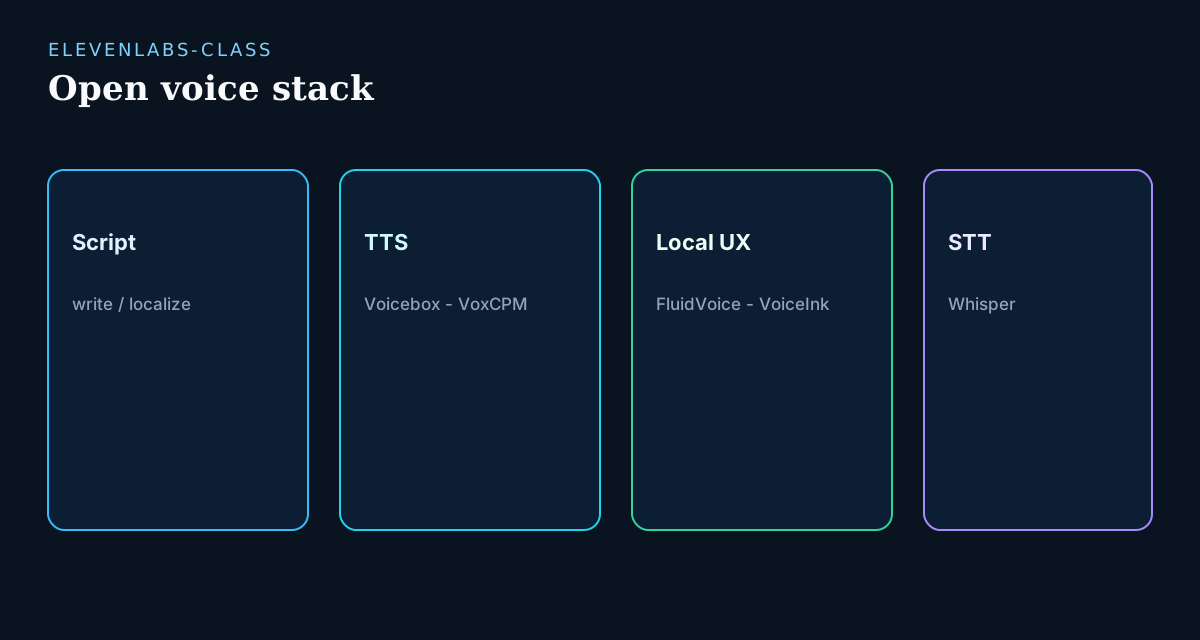
Decide your job first: (1) narrate scripts, (2) clone a consented voice, (3) dictate and transcribe, or (4) build voice into agents and apps. Those jobs map to different FOSS projects with different maturity levels—and conflating them is the main reason open-voice evaluations disappoint. A dictation user testing a research TTS model is measuring the wrong thing.
Key takeaways
- Voicebox and VoxCPM are strong catalog peers for open voice/TTS experimentation.
- Whisper covers the STT side many “voice AI” searches actually need.
- FluidVoice, VoiceInk, and OpenWispr help when the product gap is local UX.
- Quality, latency, and license vary wildly—benchmark on your languages.
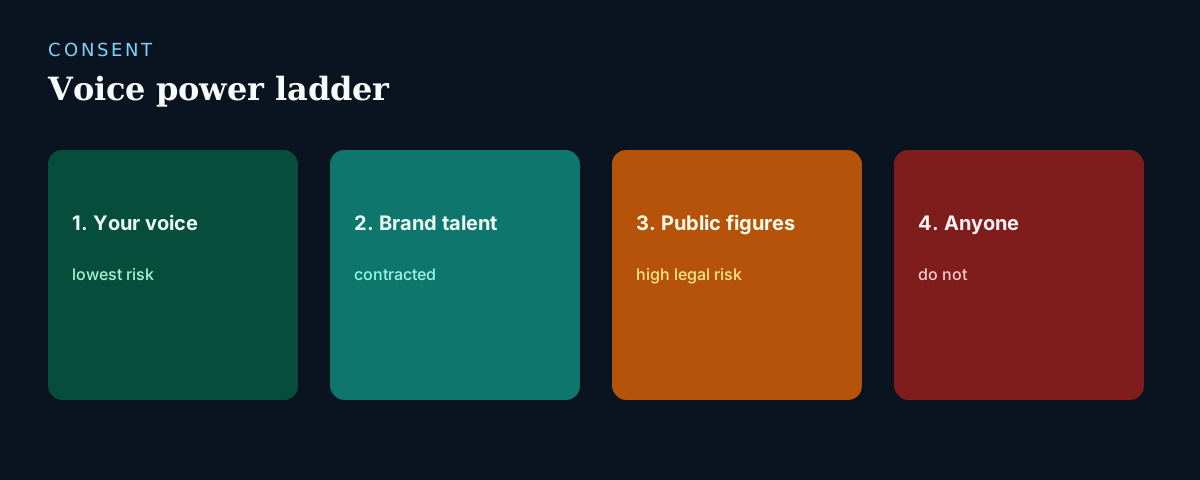
- Consent and watermarking policies matter as much as MOS scores.
- Treat voice samples like biometrics: storage, access, and deletion policies come first.
Clarify what “ElevenLabs alternative” means
The search covers at least four different jobs. Pick yours before shortlisting, because each maps to a different corner of the open ecosystem:
- Narration: turning scripts into natural long-form audio in your languages.
- Voice cloning: reproducing a consented voice for localization or scale.
- Dictation and transcription: private speech input, the Whisper/Superwhisper side.
- Voice in products: TTS/STT inside apps and agents, where latency and licensing dominate.
- Local UX: replacing the account-walled app experience, not the underlying models.
Quick comparison
| Project | Role | Best for | Notes |
|---|---|---|---|
| Voicebox | Voice / generative audio OSS | Voice experiments | Verify license and setup effort before planning production use |
| VoxCPM | Voice-related OSS | TTS/voice pipelines | Hardware sensitive; strongest in batch pipelines you control |
| Whisper | Speech-to-text | Transcription / captions | The proven half of open voice; pairs with any TTS stack |
| FluidVoice | Voice app | Local voice UX | Productized local feel when the pain is SaaS friction, not models |
| VoiceInk | Voice tooling | Creator voice workflows | Check platform support; aimed at daily creator loops |
| OpenWispr | Dictation-adjacent | Private voice input | Superwhisper-class neighbor for offline dictation |
| Supertonic / Handy | Audio/voice-adjacent | Broader audio agents | Different specialties—evaluate per job, not as TTS twins |
How we evaluated
We reviewed official repositories, model cards, documentation, release signals, deployment requirements, and both code and model licenses. Projects were compared only within the job they perform: synthesis, consented voice cloning, transcription, local voice UX, or application integration. Privacy, language coverage, hardware needs, export control, and operational burden all affect the shortlist. The catalog-level sample is published in our 2026 open-source ecosystem report.
We did not publish a subjective audio ranking without controlled samples. Before adoption, benchmark the exact languages and speakers you need, record latency and failure cases, verify commercial terms for every model, and require documented consent, access, retention, and deletion controls for voice data.
Voicebox + VoxCPM
Voicebox
Open in catalogHigh-visibility open voice project in the catalog. Strengths: generative voice research you can run, inspect, and keep entirely on your hardware—the right starting point when ElevenLabs searches mean owning the synthesis stage. Limits: research-grade setup, licensing that needs reading before commercial narration, and language coverage that must be validated on your actual scripts, not English demos. Choose it to prototype private narration or voice features offline, then benchmark against a hosted A/B before committing a content pipeline.
- Best for
- Builders prototyping narration or voice features offline.
- Deployment
- Self-managed.
- Pricing
- Open-source; check model licenses.
- Unique
- Strong headline peer for ElevenLabs-class SEO intent.
VoxCPM
Open in catalogOpen voice-related project suitable for pipeline experiments. Strengths: control over the full data path and batch generation without per-character billing—valuable inside content factories and app backends. Limits: setup cost is real, output quality is hardware- and configuration-sensitive, and you own the ops. Choose it as the second trial beside Voicebox when integrating TTS into apps or automated pipelines, where API invoices and rate limits hurt most.
- Best for
- Teams integrating TTS into apps or content factories.
- Deployment
- Self-managed.
- Pricing
- Open-source.
- Unique
- Useful second trial beside Voicebox.
Local voice UX (when SaaS polish is the pain)
FluidVoice
Open in catalogLocal-leaning voice application energy—helpful when “ElevenLabs alternative” really means “I want voice on my machine with fewer account walls.” Strengths: a productized local feel without routing audio through someone else’s cloud. Limits: it solves the UX layer, not the frontier-model layer—peak synthesis quality still depends on the models underneath. Choose it when your pain is friction and privacy in daily voice workflows rather than raw TTS research.
- Best for
- Individuals prioritizing private voice workflows.
- Deployment
- Desktop / local.
- Pricing
- Open-source.
- Unique
- Good UX-oriented entry in the ElevenLabs hub.
VoiceInk
Open in catalogCreator-oriented voice tooling in the catalog. Strengths: aimed at the writing-and-speaking loop creators actually run daily, rather than model benchmarks. Limits: check platform support for your OS, and expect a narrower scope than an API-first voice platform. Choose it when your bottleneck is chaining voice into content workflows—drafting, narrating, publishing—rather than synthesis quality itself.
- Best for
- Creators chaining voice into content pipelines.
- Deployment
- App / self-managed depending on release.
- Pricing
- Open-source.
- Unique
- Practical peer for day-to-day voice work.
OpenWispr
Open in catalogDictation-adjacent open project near Superwhisper-class searches. Strengths: private, offline speech input—the job a surprising share of “voice AI” searches actually want. Limits: it is input-side tooling, not synthesis; do not evaluate it against TTS demos. Include it when “ElevenLabs alternative” actually means private dictation rather than voice cloning, and see the Superwhisper hub for the full class.
- Best for
- Users who need offline/private dictation first.
- Deployment
- Local.
- Pricing
- Open-source.
- Unique
- Bridge between ElevenLabs and Superwhisper intents.
Whisper (the other half of voice AI)
Whisper
Open in catalogOpenAI’s open speech-to-text model and code—the proven, boring half of open voice AI. Strengths: robust multilingual transcription, a huge ecosystem of optimized runtimes, and a natural fit for captions, script recovery, and localization loops before re-synthesis. Limits: STT only, so it always needs a TTS partner for the full pipeline, and larger models want a GPU for speed. Choose it whenever your ElevenLabs workflow touches existing audio—it is usually the first stage worth automating and the least risky.
- Best for
- Anyone building bidirectional voice pipelines.
- Deployment
- Local / GPU optional by model size.
- Pricing
- Open model/code.
- Unique
- Default STT layer next to open TTS.
Selection criteria
Score open voice projects on the constraints that decide production fit, not demo impressiveness:
- Benchmark your languages and proper nouns—not English demos alone.
- Measure latency for interactive use versus batch narration; they are different products.
- Read model licenses for commercial narration before building on them.
- Store voice samples securely and define deletion policies; treat them like biometrics.
- Check maintenance activity—voice OSS moves fast and abandons fast.
- Verify watermarking/labeling options if your platforms or jurisdictions require them.
Migration playbook
Keep the ElevenLabs account until the open stack earns its place. A focused pilot:
- Day 1: pick one real script (with proper nouns and your hardest language) and generate the ElevenLabs baseline to beat.
- Days 2–3: run the same script through Voicebox/VoxCPM-class candidates; keep every sample and note setup time honestly.
- Day 4: blind A/B the outputs with three listeners who do not know which is which; measure latency for your interactive use cases separately.
- Day 5: total real costs—GPU time, setup, per-run effort—against the ElevenLabs bill for the same volume; decide per job, not globally.
- Then migrate one workflow at a time: batch narration usually moves first, interactive voice last, and consent documentation travels with every cloned voice.
What still favors paid ElevenLabs
ElevenLabs keeps genuine advantages: zero-setup multilingual cloning, consistently strong quality across dozens of languages, low-latency APIs with predictable uptime, and built-in safety tooling around voice verification. If you narrate occasionally or need many languages tomorrow, the subscription is the rational choice. Open stacks win on privacy (voice data never leaves your hardware), unit cost at real volume, license auditability, and integration freedom inside pipelines that hosted rate limits would throttle.
Frequently asked questions
- What is the best open-source ElevenLabs alternative?
- There is no single answer because ElevenLabs bundles several jobs. Voicebox/VoxCPM-class projects for synthesis experiments; FluidVoice, VoiceInk, or OpenWispr when local UX is the gap; Whisper when you need the STT side. Pick by job first, then benchmark—no single FOSS tool clones every ElevenLabs surface.
- Can open TTS match ElevenLabs quality?
- For some languages and voice styles, increasingly yes—especially for controlled long-form narration where you can iterate. For zero-setup multilingual cloning, hosted ElevenLabs usually still leads. Run a blind A/B on your own script with real listeners; demo pages are not evidence.
- Is voice cloning legal with open models?
- Open models do not grant rights to a person’s voice. You need explicit consent from the speaker, and often disclosure to audiences depending on jurisdiction and platform. Document consent, label synthetic audio where required, and keep records—the legal exposure sits with you, not the model authors.
- ElevenLabs vs Descript vs Superwhisper?
- ElevenLabs is TTS/voice-API-first; Descript is an editor with transcription at its core; Superwhisper is dictation-first. They anchor three different job families—synthesis, editing, and input. Match your actual job to the family before comparing catalogs, or every comparison will feel wrong.
- What hardware does open TTS need?
- Whisper-class transcription runs on modest hardware, with GPU acceleration for speed. Modern open TTS models range from CPU-capable to GPU-hungry—batch narration tolerates slow generation, interactive voice does not. Measure seconds of audio per second of compute on your machine; that ratio decides feasibility.
Conclusion
Ride ElevenLabs demand with a clear stack: open TTS for narration you want to own, Whisper for transcription, local apps for private UX, and strict consent at every step. The teams that succeed pick one job—usually batch narration—prove it with a blind A/B against the hosted baseline, and count true costs including setup and GPU time before moving the next workflow. Most end up hybrid: open pipelines for volume and sensitive content, hosted APIs where languages or latency still favor them. Start on the ElevenLabs hub, prove one language and one workflow, then scale the stack that earned it.
Build a stack for this use case.
Answer nine practical questions and compare three transparent architectures with costs, free limits, lock-in, and migration paths.
Build my stack