Codex searches spiked for two reasons at once: OpenAI’s coding-agent product narrative, and an open-source Codex CLI on GitHub. That mix confuses buyers—the same word covers a hosted product, an OSS repository, and a whole class of terminal agents—so this guide separates hosted Codex experiences from the OSS CLI, then shows how MCP plugs tools into either world.
If you only remember one thing: treat Codex as a class of terminal/agent workflows. Open alternatives compete on tool use, repo edits, and model choice—not on copying the Codex brand. The interesting question is never “which tool is called Codex” but “which agent handles my repo, my tests, and my secrets policy best.”
Below: the three meanings of Codex untangled, a comparison of the practical FOSS shortlist, how MCP makes plugins portable across all of them, and a pilot plan that produces a decision in a week instead of a debate that runs a quarter.
Key takeaways
- OpenAI publishes an open-source Codex CLI—verify LICENSE and what is still hosted/proprietary.
- Cline, OpenHands, Continue, Goose, and Aider remain the practical FOSS shortlist.
- MCP is how you attach plugins (git, docs, browsers) portably across agents.
- Measure agents on your monorepo: tests, multi-file refactors, secret handling.
- Codex vs Claude Code vs Cursor is a workflow comparison, not a model beauty contest.
- Keep the model layer swappable: BYO-key clients let hosted and local models compete on your tasks.
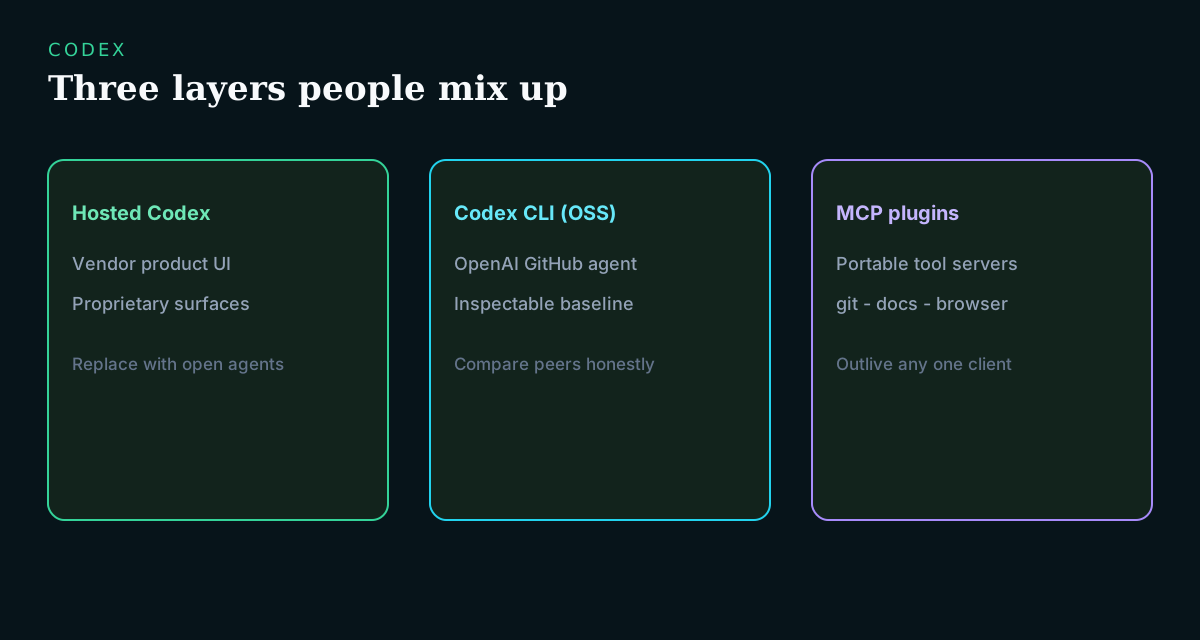
Three Codex meanings (don’t mix them)
| Meaning | What it is | Open-source angle |
|---|---|---|
| Hosted Codex / ChatGPT coding | Vendor product surfaces | Replace with open agents + BYO models |
| OpenAI Codex CLI (GitHub) | Open coding agent/CLI | Use directly or compare peers |
| “Codex-like” agents | Terminal + tool-using coders | Cline / OpenHands / Goose / Aider |
Most confusion in Codex threads comes from people arguing across rows of this table. Decide which row you are shopping in first: if you want the hosted experience, you are comparing subscriptions; if you want the OSS CLI, you are comparing repos and licenses; if you want the workflow class, the whole shortlist below is fair game.
Quick comparison
| Project | Role | Best for | Notes |
|---|---|---|---|
| OpenAI Codex CLI | OSS coding agent | Terminal agent loops | Official open entry point; the natural baseline to measure peers against |
| Cline | IDE agent | Interactive edits | Strong daily-driver candidate; approval gates on every tool call |
| OpenHands | Autonomous agent | Longer tasks | Self-host friendly; delegated tasks rather than pairing |
| Continue | IDE assistant | BYO models in editors | Copilot/Cursor overlap; chat-and-edit first, autonomy second |
| Goose | Local agent + MCP | Tool-heavy local runs | MCP-native story; tools you control are the point |
| Aider | CLI repo editor | Git-centric workflows | Fast proof of value; diffs and commits as first-class output |
| codebase-memory-mcp | MCP plugin | Repo memory | Pairs with any client; a read-mostly server to install first |
OpenAI Codex CLI
Codex (open-source CLI)
Open in catalogOpenAI’s open coding agent/CLI is the headline listing for Codex SEO. Strengths: an official OSS baseline you can read, a terminal agent loop that maps directly to the viral Codex narrative, and first-party alignment with OpenAI models. Limits: the open CLI is not the whole hosted product—some capabilities remain vendor-side—and defaults assume OpenAI's ecosystem more than a neutral client would. Choose it when you want an official reference point with a real open codebase to inspect, then decide whether hosted Codex features still matter for your team.
- Best for
- Teams evaluating Codex with a real open codebase to inspect.
- Deployment
- CLI.
- Pricing
- Open-source CLI; models/APIs may still cost money.
- Unique
- Best “source of truth” project on the Codex alternatives page.
How MCP fits Codex-class agents
MCP does not replace Codex. It standardizes plugins so the same git/docs/browser servers can serve Codex CLI, Goose, Continue, Claude Code-class clients, or ChatGPT-style UIs. That portability is the viral open-source story: tools you configure once outlive whichever agent brand wins the quarter.
- Start with Awesome MCP Servers for discovery.
- Add codebase memory / docs search before write-capable shell tools.
- Keep one agent as daily driver; avoid installing every server you find.
- Log tool calls when agents touch production-adjacent systems.
Peer agents worth piloting
 Cline
Cline
Open in catalogIDE agent loops with visible tool use. Strengths: approval checkpoints before actions, strong MCP integration, and provider-agnostic model routing. Limits: token burn on large agent sessions, and no autocomplete—it is an agent, not a completion engine. Choose it when Codex-like agency should live inside the editor with a human reviewing each step; it often wins as the interactive daily driver even when Codex CLI stays in the shortlist.
- Best for
- Developers who want Codex-like agency inside the editor.
- Deployment
- Editor extension.
- Pricing
- Open-source; models separate.
- Unique
- Strongest IDE peer for many Codex migrations.
OpenHands
Open in catalogLonger-horizon coding agent. Strengths: real multi-step autonomy with a self-hostable, sandboxable runtime. Limits: heavier setup than a CLI install, and unattended runs need genuine guardrails before you trust them. Choose it when Codex for you means “delegate a task and review the result,” not “pair in the editor”—it is the best Devin-adjacent open option in the same conversation as Codex.
- Best for
- Teams testing autonomous coding with supervision.
- Deployment
- Self-hosted / local.
- Pricing
- Open-source.
- Unique
- Best Devin-adjacent open option in the same conversation as Codex.
Goose
Open in catalogLocal agent runtime that pairs naturally with MCP plugins. Strengths: MCP-native tool discovery, local-first execution, and full auditability of the agent loop. Limits: configuration-heavy, and quality tracks the model you attach. Choose it when Codex searches are really about tool-using agents you control—the tools travel with you even if you later switch to Codex CLI or an IDE agent.
- Best for
- Builders who want auditable local agents.
- Deployment
- Local.
- Pricing
- Open-source.
- Unique
- Best MCP-forward peer in the Codex shortlist.
Selection criteria
Whichever row of the Codex table you shop in, score candidates on the constraints that survive past the demo:
- Repo reality: can it complete a multi-file refactor with passing tests on your codebase?
- Tool transparency: are shell/file actions visible and gated, or silent?
- Model freedom: OpenAI, Anthropic, and local models without forked configs?
- Secrets: env/vault per tool, never in prompt text—and can you verify that?
- Cost visibility: token spend per task, measured on a real PR, not estimated.
- License and maintenance of both the agent and every MCP server you attach.
One-week pilot plan
A Codex-class decision does not need a quarter of evaluation. Run this instead:
- Day 1: install Codex CLI and one peer (Cline for IDE, Aider for terminal) on a secondary but real repository.
- Days 2–3: route daily work through each; note every fallback to your current tool and why.
- Day 4: give both the same test-fixing task and the same refactor; compare diffs, tokens, and wall-clock time.
- Day 5: add one MCP server (repo memory or docs search) to the winner and confirm the workflow still holds.
- Decide on evidence: adopt, extend the pilot, or stay put—then document the config for the next developer.
What still favors hosted Codex
The hosted Codex experience bundles tuned models, managed execution environments, and integration with the rest of OpenAI's product surface—conveniences the OSS CLI plus BYO infrastructure make you rebuild yourself. If your team values zero-setup delegation and already lives in OpenAI's ecosystem, hosted may genuinely be the right call. The open path wins when you need to inspect the agent, control where code goes, swap model providers, or attach tools the hosted surface does not allow.
Frequently asked questions
- Is OpenAI Codex open source?
- OpenAI publishes an open-source Codex coding agent/CLI, which you can read, fork, and run. Hosted Codex experiences and the underlying models can still be proprietary. Always verify the repo LICENSE and be precise about which runtime you are comparing—the CLI and the hosted product are not the same thing.
- Does Codex support MCP plugins?
- Compatibility depends on the client/runtime version and changes across releases. The open strategy is: MCP servers plus whichever agent speaks MCP today—your git, docs, and browser tools stay portable if you switch from Codex CLI to Goose, Cline, or a future client.
- Codex vs Claude Code vs Cursor?
- Codex and Claude Code are agent-oriented; Cursor is an AI-first editor. Shortlist by workflow—terminal agent, IDE agent, or editor-native chat/edit—and by which hours of your day the tool covers. Brand-versus-brand comparisons without a workflow anchor produce debates, not decisions.
- Can I run Codex-like agents with local models?
- Many open agents support local runners or BYO keys, and for routine edits local models often suffice. Expect trade-offs in reasoning quality and latency versus frontier hosted models on hard multi-step tasks. A hybrid—local for sensitive repos, hosted for hard problems—is common and reasonable.
- What does a Codex-class open stack cost?
- The agents are free; models and infrastructure are not. Agent loops make many model calls, so token costs can exceed a subscription for heavy users—measure one real PR's spend during the pilot. Self-hosting OpenHands-style runtimes adds infra and ops time to the bill.
- Where should I start in the catalog?
- Open the Codex alternatives hub, open the Codex CLI project page, then run the one-week pilot above. Add MCP only after one repository workflow succeeds—tools attached to a workflow that does not work yet just multiply the confusion.
Conclusion
Ride the Codex wave with clarity: know which of the three Codex meanings you are buying, use the open CLI when it fits, and compare peer agents on your repository rather than on release notes. The one-week pilot settles most debates—same repo, same tasks, measured tokens and diffs. Attach tools via MCP so plugins outlive any single vendor UI, and keep the model layer swappable so providers compete for your workload. Whether you land on Codex CLI, Cline, or Aider, the durable win is the same: an agent stack you can audit, reconfigure, and take with you.
Build a stack for this use case.
Answer nine practical questions and compare three transparent architectures with costs, free limits, lock-in, and migration paths.
Build my stack