Bitchat is useful when a group needs a local communication path after mobile data, Wi-Fi, or a messaging service becomes unavailable. It is not a substitute for a tested emergency plan, and its encrypted message content should not be confused with anonymity. The most important adoption detail in July 2026 is a release gap: the latest stable iOS release is version 1.7.0 from July 8, while significant privacy documentation, device-seizure hardening, relay controls, and build-verification fixes landed on the main branch on July 26.
OpenSourceChoice verdict: evaluate Bitchat as a rehearsed, supplementary channel for nearby people. Do not make the current stable app the only communications system for a high-risk event, and do not assume that Bluetooth address randomization hides a persistent Bitchat identity. For Android threat-sensitive deployments, also resolve the repository's contradictory licensing statements before redistribution or integration.
Methodology: This is a researched analysis of the current repositories, documentation, releases, security policy, App Store listing, and relevant upstream changes as observed on July 28, 2026. OpenSourceChoice did not perform a radio-range test, code audit, penetration test, or field deployment.
Why this matters now
Bitchat is receiving attention for reasons that go beyond a single launch post. It was among the leading repositories on GitHub Trending on July 28, while its iOS and Android repositories continued to receive commits. Separate discussions about access restrictions in India and real-world use during connectivity disruptions also revived interest in phone-to-phone messaging.
The timing is technically important, not just socially interesting. On July 26, the iOS maintainers merged a cluster of changes covering device-seizure exposure, Tor and relay controls, source verification, and corrections to inaccurate privacy claims. Those changes make the project's current limits easier to evaluate, but they do not retroactively update version 1.7.0 already distributed through the App Store.
That distinction should drive an adoption decision:
- Current interest is real: repository activity, trending visibility, and independent community discussions align.
- The stable release is not the current main branch: recent hardening needs a new tagged and distributed build before ordinary users receive it.
- The risk is contextual: local relaying can be valuable during outages, but stable identifiers, radio proximity, and retained data can be dangerous when anonymity or device seizure is part of the threat model.
What Bitchat actually provides
Bitchat combines two transport paths:
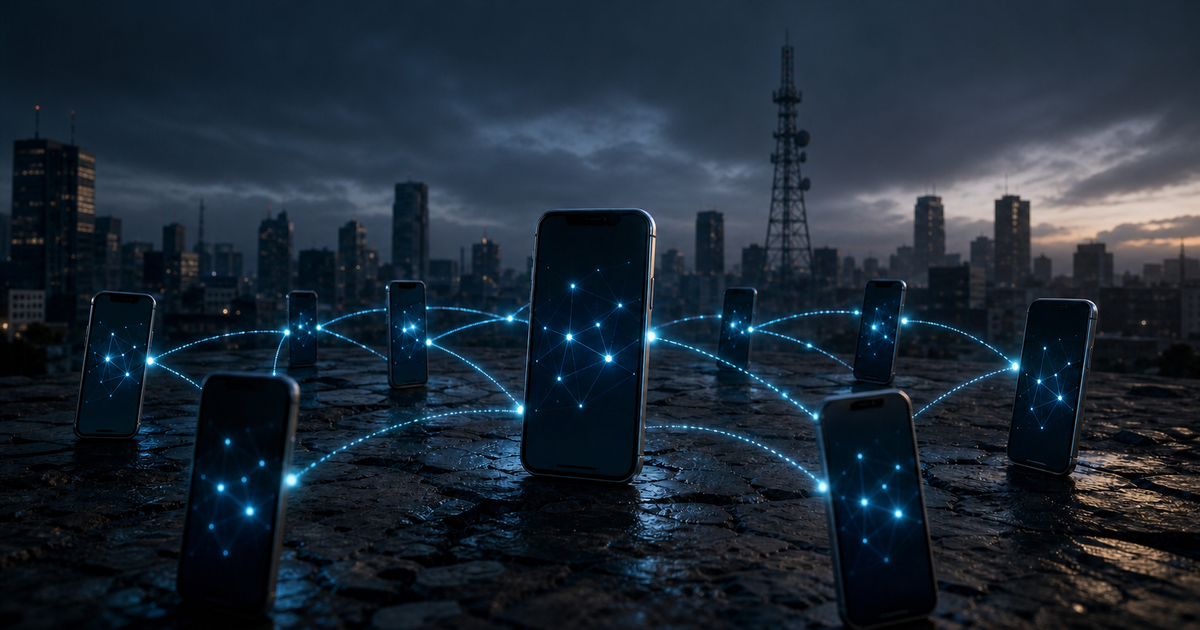
- A local Bluetooth Low Energy mesh. Nearby phones discover peers and relay packets through intermediate devices. The current protocol permits up to seven hops and uses store-and-forward behavior so a temporarily disconnected recipient can receive queued content later.
- An internet path through Nostr relays. When connectivity exists, the app can use public or custom relays for broader delivery. Tor can protect the direct network path when it is enabled and working.
The app does not require a phone number, email address, or project-hosted account. Private conversations use a Noise XX handshake with X25519 and ChaCha20-Poly1305. Public rooms and location-based channels have different privacy properties: their content and participation are intentionally visible to nearby peers or relay observers.
This architecture solves a specific problem: short-range communication can continue without a centralized server. It does not create long-distance connectivity from phones alone, guarantee delivery, hide the existence of a transmitter, or make every message mode end-to-end private.
Current release and platform reality
| Platform | Latest stable release observed | Distribution | Practical implication |
|---|---|---|---|
| iOS | 1.7.0, released on GitHub July 8 and listed by Apple July 9, 2026 | App Store or source build | The safest mainstream installation path, but it predates the July 26 hardening on main. |
| Android | 1.7.4, released June 17, 2026 | GitHub release or source build | Requires Android 8 or later; foreground operation and vendor battery policies still need device-specific testing. |
Current iOS main | Active through July 26, 2026 | Source only | Contains newer security and privacy work, but is not a stable release and should not be treated as one. |
Apple's listing says the developer reports collecting no data, but Apple also states that the declaration has not been independently verified. The absence of a project-owned analytics backend is useful, yet it does not eliminate data exposure to nearby radios, Nostr relays, network providers, or someone who unlocks the device.
Reliability depends on people, distance, and operating systems
A mesh is only as useful as the path it can form. One phone can reach only nearby peers; additional phones can extend the path if they remain within radio range, keep the app operational, and relay compatible packets. Buildings, crowds, interference, device placement, operating-system scheduling, and battery-saving behavior can all change the result.
This creates a density threshold. Bitchat may be effective inside a venue, neighborhood cluster, convoy, campus, or organized team. It is much less convincing when participants are geographically dispersed or when the expected route depends on unknown strangers keeping the app active.
The protocol includes duplicate suppression, hop limits, fragmentation, and queued delivery, but those mechanisms cannot promise availability. A jammer, sparse topology, powered-off phones, an operating-system background restriction, or a partition lasting longer than the queue retention period can break delivery. Public mesh history is gossiped for up to six hours, while some outbox and courier material can remain for up to 24 hours.
An evaluation therefore needs real phones and the real environment. A simulator cannot reproduce the radio, background-execution, and battery constraints that matter most.
Encryption protects content better than identity
The project's July privacy assessment documents a crucial distinction: private message encryption does not erase metadata.
The current on-air protocol derives a stable eight-byte sender identifier from a static key. Announcements can expose that identifier, public key material, and nickname in cleartext. Neighbor identifiers reveal part of the local connection graph, and the original time-to-live value can help an observer estimate a sender's hop distance. Because that application identifier remains stable, a passive scanner may correlate a device across sessions and locations even though iOS randomizes its Bluetooth address.
For private mesh conversations, Noise XX provides forward-secret encrypted sessions. The Nostr mailbox path has a different design. The project's proprietary sealed envelopes are not NIP-17, NIP-44, or NIP-59, and the documentation says stored envelopes do not provide forward secrecy if the recipient's long-term static key is later compromised. Relays can also observe a recipient public-key tag, message timing, approximate size, and the connecting network address unless Tor is protecting that connection.
The responsible interpretation is:
- Private message content has meaningful cryptographic protection.
- Public channels are public by design.
- A local observer can still learn proximity and relationship information.
- An internet relay can still learn delivery metadata.
- “No account” does not mean “no persistent identifier.”
For activists, journalists, or people exposed to targeted surveillance, the stable radio identity is not a minor technical footnote. It can be the principal risk.
The stable-release gap is the immediate production blocker
The July 26 upstream work improved the project's security posture in several concrete ways. It added hidden notification previews and an app-switcher cover, aligned media and archive deletion with retention settings, made Tor failure visible, added custom relay controls, tightened source-manifest verification, and disconnected removed relays correctly. The maintainers also published the first formal security policy and corrected documentation that had overstated unlinkability, storage protection, padding, and message-history behavior.
Those corrections are a positive sign: maintainers accepted specific findings and documented the remaining limits. But they also show why a stable build must be evaluated by its own code, not by newer documentation on main.
For a high-risk deployment, the minimum release gate should be:
- a new signed iOS tag that includes the July 26 changes;
- an App Store build mapped to that tag;
- a documented check that the installed binary is the intended version;
- real-device validation of locked-screen previews, app-switcher snapshots, media expiry, archive deletion, Tor failure, and relay removal;
- a re-read of the privacy assessment for unresolved items.
Until then, installing version 1.7.0 is a calculated compromise, not adoption of the newest hardening.
Device seizure remains a separate threat
The current main branch reduces casual exposure on a locked phone, but the project's own assessment does not claim a complete seizure-resistance model. There is no independent app PIN, duress mode, or secondary encryption boundary that remains effective after the operating system is unlocked. Retained conversations and media can therefore become visible under coercion or device compromise.
Media stored by the app is also not protected by a separate application-layer sealed vault. File protection depends heavily on platform behavior, and the assessment flags weaker guarantees on macOS. Retention controls help only if they are configured, tested, and allowed to expire before access occurs.
Teams with a seizure threat should treat device minimization, short retention, notification settings, screen-lock policy, and a practiced loss response as part of the system. Choosing an encrypted messenger does not replace those controls.
Supply-chain verification is improving, but incomplete
The official guidance recommends the App Store for most iOS users, followed by building from verified source. The repository publishes source manifests and attestations so reviewers can compare the expected tree. A July 26 fix closed a weakness where the manifest checker could accept added files.
There are still limits. The project does not currently publish an independent signing-key fingerprint, a reproducible-build pipeline, or a non-GitHub source mirror. A compiled copy from an unofficial mirror cannot be proven equivalent to the reviewed source. That makes random APK or IPA mirrors especially inappropriate in a censorship or high-risk context.
For Android, the repository adds a legal uncertainty. Its README describes the project as public domain, while the current LICENSE.md contains GPL-3.0 terms. The license file is the more concrete legal artifact, but the contradiction should be resolved upstream before a business embeds, modifies, or redistributes the client. The iOS repository uses the Unlicense.
Cost, lock-in, and operating burden
Bitchat has no subscription fee and no required project-operated server. That does not make adoption free:
- participants need compatible phones and enough battery;
- iOS and Android behavior must be tested separately;
- teams need a distribution and update process;
- custom Nostr relays or Tor bridges require additional administration if public defaults are unsuitable;
- real drills consume staff time and reveal topology gaps;
- incident procedures must cover lost devices, stale builds, and compromised long-term keys.
Data is stored in platform-local formats and transported through a Bitchat-specific protocol. There is no proprietary cloud account to trap users, but migration is not the same as exporting a conventional chat archive into another messenger. The practical exit strategy is procedural: keep contact lists and emergency instructions outside the app, maintain a second channel, and avoid making Bitchat the only copy of essential information.
Alternatives to evaluate in parallel
| Alternative | Better fit | Main trade-off |
|---|---|---|
| Briar | Android teams that prioritize a mature adversarial threat model, Tor connectivity, direct Bluetooth/Wi-Fi sync, and an app lock | No iOS client; still needs real-device and contact workflow testing. |
| Meshtastic | Longer-range community or field networks where participants can carry dedicated LoRa radios | Requires hardware, radio configuration, charging, and local regulatory awareness; routing metadata is not fully hidden. |
| SimpleX Chat | Internet-connected messaging where avoiding permanent user identifiers is more important than local offline mesh | Depends on network reachability and messaging servers; it is not a Bluetooth outage mesh. |
Briar is the most important software-only comparison for an Android high-risk cohort. Meshtastic addresses a different physical problem: it trades phone-only convenience for substantially different radio range and dedicated hardware. SimpleX is useful as an internet privacy baseline, not as an outage substitute.
A practical evaluation plan
Do not start with a broad rollout. Use a small, disposable pilot and measurable rejection criteria.
1. Verify the build
- Record the exact version and source tag for every platform.
- Install only from the official store or repository.
- Reject unsigned mirrors and undocumented repackaging.
- On iOS, treat the July 26 changes as unavailable until a stable tag and App Store build include them.
2. Model the actual threat
Write down which risks matter: service outage, local radio observation, relay observation, device seizure, targeted malware, misinformation, or physical separation. If persistent radio correlation or coerced unlock is unacceptable, current Bitchat may fail before a field test begins.
3. Run a two-hour field drill
Use at least six real devices across the intended building or route. Disable internet access, allow normal screen locking, and measure:
- delivery success within 60 seconds;
- longest successful path and number of relays;
- recovery after a 15-minute partition;
- battery loss per hour;
- behavior when intermediate phones lock or background the app;
- duplicate, delayed, and missing messages;
- iOS-to-Android compatibility for every required message type.
A reasonable initial gate is at least 95% delivery for priority text messages within the team's stated time target, with no single relay whose loss partitions the planned route. The organization may need a stricter threshold; the important part is deciding it before the test.
4. Test privacy and loss controls
- Observe what appears on the lock screen and in the app switcher.
- Confirm how public rooms, nicknames, geohashes, and nearby peers are exposed.
- Verify message, media, and archive expiry on every platform.
- Remove a relay and confirm the client actually disconnects.
- Test Tor failure as a visible failure, not an assumed protected state.
- Simulate a lost unlocked phone and document what remains accessible.
5. Rehearse the fallback
Give every participant a second communication method and a written rendezvous plan. Repeat the drill after an app update. Reject the rollout if users cannot identify public versus private modes, if the stable build cannot be mapped to reviewed source, or if the mesh fails in the real environment.
Who should adopt it—and who should wait
Good evaluation candidates: nearby technical teams, conference or campus groups, neighborhood preparedness pilots, and developers researching phone-only delay-tolerant networks. They can benefit from local relaying and can afford to test failure modes rather than assume coverage.
Use only as a secondary channel: civil-society groups and field teams facing intermittent connectivity. They need a specific threat model, controlled builds, short retention, real-device drills, and an independent fallback.
Wait or choose another tool: users who need guaranteed delivery, long-distance radio coverage without participant density, strong resistance to device seizure, or protection from persistent local radio tracking. Organizations planning commercial Android redistribution should also wait for unambiguous licensing guidance.
The project is active and unusually transparent about several weaknesses it still needs to solve. That is a better foundation than vague privacy marketing. The correct conclusion, however, is operational rather than ideological: Bitchat can add resilience at short range, but resilience exists only after the exact stable build, devices, topology, metadata exposure, and fallback plan have survived a realistic drill.
Sources
Primary sources were accessed on July 28, 2026 unless another date is stated.
- Bitchat iOS repository and README — Permissionless Tech; current architecture, installation, license, and repository status.
- Bitchat iOS v1.7.0 release — Permissionless Tech; released July 8, 2026.
- Bitchat Mesh App Store listing — Apple and Permissionless Tech; version 1.7.0 listed July 9, 2026.
- Bitchat Whitepaper 2.0 — Permissionless Tech; dated July 6, 2026; transport, cryptography, retention, metadata, and protocol limits.
- Privacy and security assessment — Permissionless Tech; last reviewed July 2026; verified properties and unresolved risks.
- Security policy — Permissionless Tech; added July 26, 2026; support scope and reporting process.
- Device-seizure hardening, PR #1484 — Permissionless Tech; merged July 26, 2026.
- Privacy claim corrections, PR #1485 — Permissionless Tech; merged July 26, 2026.
- Censorship-resilience controls, PR #1486 — Permissionless Tech; merged July 26, 2026.
- Verification review fixes, PR #1488 — Permissionless Tech; merged July 26, 2026.
- Verifying a Bitchat build — Permissionless Tech; supported verification path and current supply-chain limitations.
- Bitchat Android repository — Permissionless Tech; platform requirements, architecture, and current activity.
- Bitchat Android v1.7.4 release — Permissionless Tech; released June 17, 2026.
- Bitchat Android GPL-3.0 license file — Permissionless Tech; compared with the repository README's public-domain statement.
- Noise Protocol Framework specification — official specification; cryptographic protocol context.
- How Briar works and official downloads — Briar Project; transport, threat model, app lock, and supported distribution.
- Meshtastic overview — Meshtastic; LoRa hardware, mesh routing, and encryption boundaries.
- SimpleX protocol overview — SimpleX Chat; identifier and server model.
Discovery and interest signals, not used as sole evidence for technical claims:
- GitHub Trending — Bitchat appeared among the leading daily repositories on July 28, 2026.
- Original Hacker News discussion — community interest and criticism following the initial public release.
- Reddit discussion of access restrictions in India — independent current-interest signal; technical conclusions above rely on upstream sources.
Build a stack for this use case.
Answer nine practical questions and compare three transparent architectures with costs, free limits, lock-in, and migration paths.
Build my stack