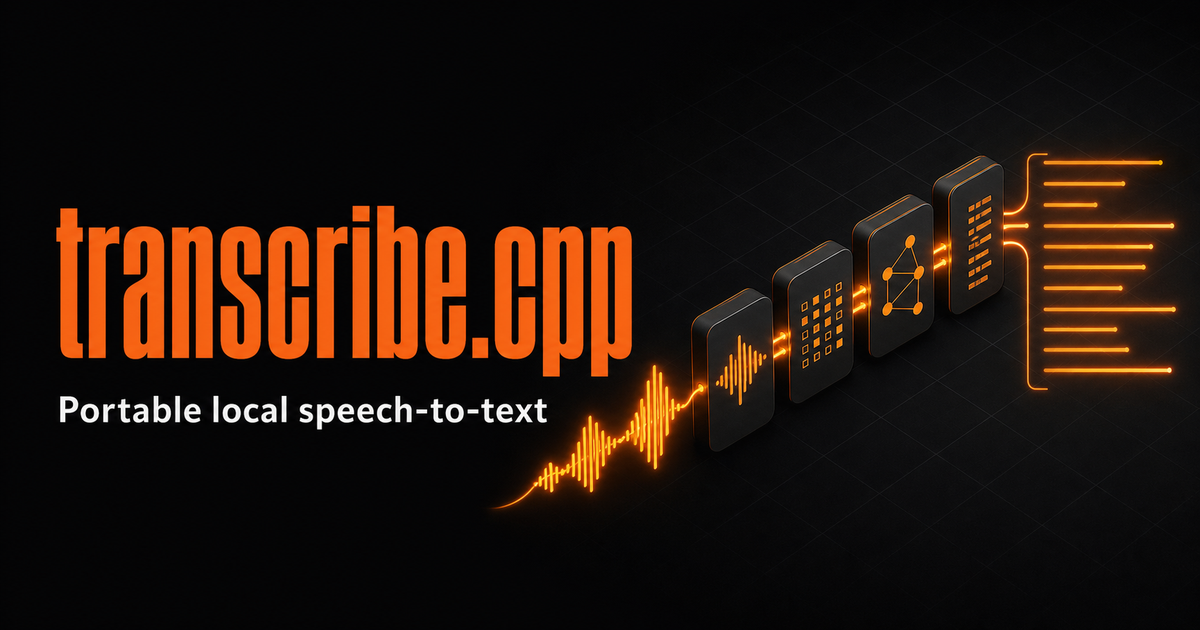
The strongest reason to evaluate transcribe.cpp is not that it runs Whisper locally. Mature projects already do that. Its more interesting proposition is one native interface for several speech-to-text model families, with GGUF model files and CPU, Metal, Vulkan, or CUDA execution behind the same application boundary.
That could let a product team change speech models without replacing its complete inference layer. It could also reduce the need to upload private audio to a hosted transcription API. But transcribe.cpp is a young 0.x library, not a finished transcription service, and model portability is not the same as production portability.
This is a researched technical assessment of version 0.1.3 and the repository state observed on July 21, 2026. OpenSourceChoice did not run an independent accuracy or performance benchmark for this article.
The verdict
transcribe.cpp deserves a controlled pilot when a desktop application, edge product, or private internal tool needs local speech recognition and wants to compare more than one model family behind a C-compatible API.
It is not yet the conservative default for a critical transcription service. Version 0.1.3 was released on July 12, the public API remains pre-1.0, the Python binding still describes itself as in development, and current repository history is highly concentrated around one maintainer. The project also has no published security policy.
For production evaluation, compare it directly with whisper.cpp and at least one ONNX-based runtime. Pin a release, pin every model artifact, test on every target CPU and GPU, and require workload-specific word error rate and failure testing before adoption.
Why this matters now
Three separate signals make the project timely rather than merely new:
- Mozilla.ai announced the project on June 30 after supporting it through the Builders in Residence program.
- The repository appeared on GitHub Trending on July 21.
- A Hacker News discussion submitted on July 19 attracted substantial developer attention and technical debate.
The technical activity also supports the trend signal. Stable releases 0.1.1, 0.1.2, and 0.1.3 followed quickly in July, and the main branch received additional model and diarization work after 0.1.3. This is active development, not an abandoned demonstration.
The timing also reflects a broader adoption problem. Speech models are improving across different research stacks, but an application that integrates each reference implementation separately inherits several build systems, tensor formats, acceleration paths, and deployment assumptions. A common local runtime can be valuable even when it does not create a better model.
What transcribe.cpp actually does
The project is a C/C++ inference library built on ggml. Its current documentation describes support for 16 model families and more than 60 variants, including Whisper, Parakeet, Canary, Moonshine, Qwen3-ASR, SenseVoice, Granite Speech, Voxtral, and others.
The application-facing shape is comparatively small:
- Load a supported model converted to GGUF.
- Select an available compute backend.
- Pass normalized audio to a session.
- Read batch or streaming transcription results.
The repository provides a public C API and official bindings for Python, TypeScript/JavaScript, Rust, and Swift/Objective-C. Prebuilt GGUF files are published under the handy-computer organization on Hugging Face, while conversion and quantization tools support teams that need another precision or checkpoint.
The command-line example accepts 16 kHz mono WAV. The Python API expects 16 kHz mono float32 PCM and deliberately does not decode containers or resample audio. Real applications therefore still need capture, decoding, downmixing, resampling, buffering, and output handling around the runtime.
What it does not provide
transcribe.cpp is not a hosted API or a complete self-hosted service. It does not provide user authentication, tenant isolation, a durable job queue, an administration console, storage lifecycle rules, autoscaling, billing controls, or an operational dashboard.
It also does not make every supported model equivalent. Different model families have different language coverage, context limits, timestamp behavior, streaming support, memory requirements, accuracy profiles, and licenses. A shared API reduces integration work; it cannot erase model-specific behavior.
Teams that need a ready meeting recorder, voice-typing application, subtitle editor, or call-center platform should evaluate products built above an inference runtime rather than treating this library as the complete product.
Architecture and portability
The core library uses C++17 and exposes a single-header public C API. ggml is vendored at a pinned revision, and the runtime can use Metal on Apple Silicon, Vulkan on Windows and Linux, CUDA on supported NVIDIA systems, or CPU execution. The project recommends OpenBLAS for faster host-side decoding and includes tinyBLAS kernels by default.
This architecture has two useful portability properties:
- GGUF creates a consistent distribution format for converted model weights.
- The C ABI gives several language bindings a common native implementation.
The trade-off is a larger native supply chain. Application teams must track the runtime, vendored ggml, platform toolchains, GPU drivers, native provider packages, model files, audio preprocessing, and binding versions. A Python wheel simplifies installation, but it does not remove those underlying compatibility boundaries.
Portability must therefore be proven on the oldest CPU, operating system, and driver you intend to support. An inference library that works on a developer's current GPU can still fail on an older office laptop or a minimally provisioned server.
Stable release versus the main branch
The latest stable release at research time is v0.1.3, published on July 12, 2026. Its release provides native archives for Linux, macOS, and Windows, Python artifacts, CUDA-specific wheels, and an Apple XCFramework. The Python packages are also published on PyPI through Trusted Publishing with provenance tied to the release tag.
The main branch is already ahead of that release. Three merged changes after v0.1.3 add multi-talker and diarization-related work. Those changes are useful evidence of active development, but they are not part of v0.1.3.
Production teams should not combine claims from the main-branch README with a deployment pinned to the stable package. Record the exact runtime tag, model file, quantization, backend, and binding version used for every benchmark.
Installation and operational cost
The simplest Python evaluation starts from the versioned package:
python -m venv .venv
pip install "transcribe-cpp==0.1.3"
Native applications can use the release archives or build with CMake. The repository documents additional flags for Vulkan and CUDA builds, and provides a dedicated Windows build guide.
There is no runtime license fee, but adoption is not zero-cost. Budget for:
- model storage and distribution;
- CPU or GPU capacity sized for peak audio volume;
- audio decoding and resampling;
- platform-specific packaging and driver support;
- regression benchmarks for every runtime or model upgrade;
- monitoring for latency, truncation, crashes, and empty transcripts;
- security review of native code and downloaded model artifacts;
- operator time for releases and incident response.
The Python binding notes that 0.x permits one run or stream at a time per loaded model. A server handling concurrent jobs may need several model workers, which changes memory use and capacity planning. Measure process-level concurrency instead of extrapolating from a single CLI run.
Privacy and data flow
Local inference can keep raw audio and transcripts inside a device or private network. That is a meaningful advantage for confidential meetings, accessibility features, regulated workflows, and offline products.
However, “local” describes the inference location, not the complete data flow. Verify:
- where the application stores recordings and transcripts;
- whether crash reports, logs, or analytics contain audio or text;
- how model files are downloaded and updated;
- whether temporary decoded audio is securely deleted;
- which users and processes can access the model and transcript directories;
- whether any optional post-processing sends text to an external language model.
For sensitive deployments, test with outbound network access blocked after model provisioning. A successful offline run is stronger evidence than a privacy statement in application copy.
Security and supply-chain risk
The project has several positive supply-chain signals: tagged release artifacts publish checksums, PyPI artifacts include Trusted Publishing attestations, and model-family contributions are expected to include numerical validation and word-error-rate testing against reference implementations.
The important limitation is governance. GitHub currently reports no SECURITY.md and no published security advisories. No published advisory does not mean no vulnerability; it means consumers do not yet have a documented private reporting and disclosure path.
The issue tracker also shows the kind of compatibility work expected from a young native runtime. At research time, one issue described tail truncation when using an initial prompt with Whisper, with a proposed fix in an open pull request. Another issue reported an illegal-instruction crash on a Windows x64 CPU configuration.
Before production:
- verify release and model hashes in your artifact pipeline;
- mirror approved artifacts instead of downloading arbitrary latest files at runtime;
- fuzz or reject malformed audio inputs at the application boundary;
- sandbox the worker that parses audio and loads model files;
- pin drivers and native dependencies;
- define an internal vulnerability response process while the upstream project lacks one.
License and commercial use
The runtime is MIT licensed. Its vendored ggml and miniz components are also documented as MIT licensed. That is permissive for modification, redistribution, and commercial integration.
The runtime license does not automatically cover every model weight. Each GGUF artifact derives from a model with its own license, acceptable-use terms, language scope, and sometimes gated access. The repository explicitly marks at least one supported model as gated.
A commercial review must therefore track two separate layers:
- the MIT-licensed inference code and bindings;
- the license and terms for the exact model checkpoint deployed.
Keep the model card, source checkpoint, conversion revision, license text, and artifact hash in the release record. Switching model families can change legal obligations even when no application code changes.
Maturity and maintainer concentration
The project is active, but it is young. GitHub's contributor view currently attributes the repository's commit history to one contributor, CJ Pais. External issue reports and pull requests exist, yet release authority and architectural knowledge remain concentrated.
That does not make the project unsuitable. It does make forkability part of the evaluation. Confirm that your team can rebuild the native library, regenerate bindings, reproduce model conversion, and carry a small patch if upstream response slows.
The rapidly changing main branch is another maturity signal. Fast model support is useful for experimentation; production consumers should prefer predictable release cadence, changelogs, API compatibility notes, and longer validation windows.
Where it is a strong fit
transcribe.cpp is most compelling for:
- desktop or mobile-adjacent applications that need offline transcription;
- edge devices where hosted API latency or connectivity is unacceptable;
- privacy-sensitive internal tools with controlled hardware;
- teams comparing several ASR families behind one native boundary;
- products that already have C/C++ packaging expertise;
- research-to-product work that needs GGUF distribution and repeatable local inference.
Where it is not yet the best fit
Choose a more established or higher-level option when:
- one supported Whisper model already meets the requirement;
- you need a managed API with service-level guarantees;
- your team cannot maintain native builds and GPU compatibility;
- you need multi-tenant queues, observability, retention, and access controls out of the box;
- the target hardware is highly fragmented and cannot be tested comprehensively;
- a regulated production process requires an upstream security policy and mature disclosure history.
Alternatives to evaluate in parallel
whisper.cpp is the conservative comparison when Whisper alone is sufficient. It has a mature ecosystem and the same broad local-inference philosophy, but does not aim to make many unrelated ASR families interchangeable.
sherpa-onnx is the strongest architectural counterpoint for offline speech. It supports multiple platforms and speech tasks through ONNX Runtime, making it useful when an existing ONNX toolchain matters more than GGUF.
faster-whisper is relevant for Python services built around CTranslate2, especially when a well-understood Whisper deployment is preferable to a broader experimental model matrix.
The correct comparison is not “which repository has more models?” It is which runtime meets accuracy, latency, memory, packaging, licensing, and recovery requirements on your real hardware.
A practical two-week evaluation
Start with one stable runtime version and two model families. Use representative audio across every required language, accent, microphone, noise level, and duration.
Measure:
- word error rate against human-reviewed transcripts;
- real-time factor at p50 and p95;
- peak resident memory and GPU memory;
- cold-start and model-load time;
- streaming partial-result stability;
- timestamp and punctuation quality;
- failure rate on corrupt, silent, clipped, and long audio;
- behavior under concurrent workload;
- package size and upgrade time;
- outbound network requests after provisioning.
Run the same corpus through whisper.cpp or your current service. Blind the transcript review when possible. Include proper nouns and domain terminology, because aggregate English benchmarks often hide the errors that make a product unusable.
Adopt only if the chosen configuration meets written thresholds on every target platform and the team can reproduce the build from pinned sources. Reject or defer if one model wins a demo but packaging, concurrency, or upgrade behavior remains unpredictable.
OpenSourceChoice assessment
- Best for: Teams building local speech features that genuinely need more than one model family.
- Not for: Organizations seeking a ready multi-tenant transcription platform or a zero-operations replacement for a hosted API.
- Why now: Mozilla.ai's launch, current repository activity, GitHub Trending, and sustained developer discussion align.
- Real cost: Native packaging, model distribution, hardware, benchmarking, and upgrade operations.
- Main risk: Early 0.x maturity, maintainer concentration, and no upstream security policy.
- Production gate: Accuracy and reliability benchmarks on every target CPU/GPU using pinned release and model artifacts.
- Parallel alternative: Start with
whisper.cpp; addsherpa-onnxwhen multi-model portability is a core requirement. - Recommendation: Pilot version 0.1.3 behind an internal adapter; do not couple a critical product directly to the evolving main branch.
Sources
Primary sources, accessed July 21, 2026 unless otherwise noted:
- transcribe.cpp repository and current documentation — handy-computer; repository state and architecture.
- v0.1.3 release — handy-computer; released July 12, 2026; stable artifacts and checksums.
- Announcing transcribe.cpp — Mozilla.ai, Davide Eynard; published June 30, 2026.
- Python package and native provider package — PyPI; version 0.1.3 provenance and platform wheels.
- Model-family testing requirements — handy-computer; validation methodology on the main branch.
- Project security overview — handy-computer; security-policy and advisory state.
- Whisper tail-truncation issue and proposed fix — handy-computer; current compatibility evidence.
- Windows illegal-instruction issue — handy-computer; current platform compatibility evidence.
- Official GGUF model collection — handy-computer on Hugging Face; model artifacts and model cards.
- whisper.cpp, sherpa-onnx, and faster-whisper — official alternative repositories.
Trend-discovery sources, not used as primary evidence for technical claims:
- GitHub Trending — observed July 21, 2026.
- Hacker News discussion — submitted July 19, 2026.
Build a stack for this use case.
Answer nine practical questions and compare three transparent architectures with costs, free limits, lock-in, and migration paths.
Build my stack