
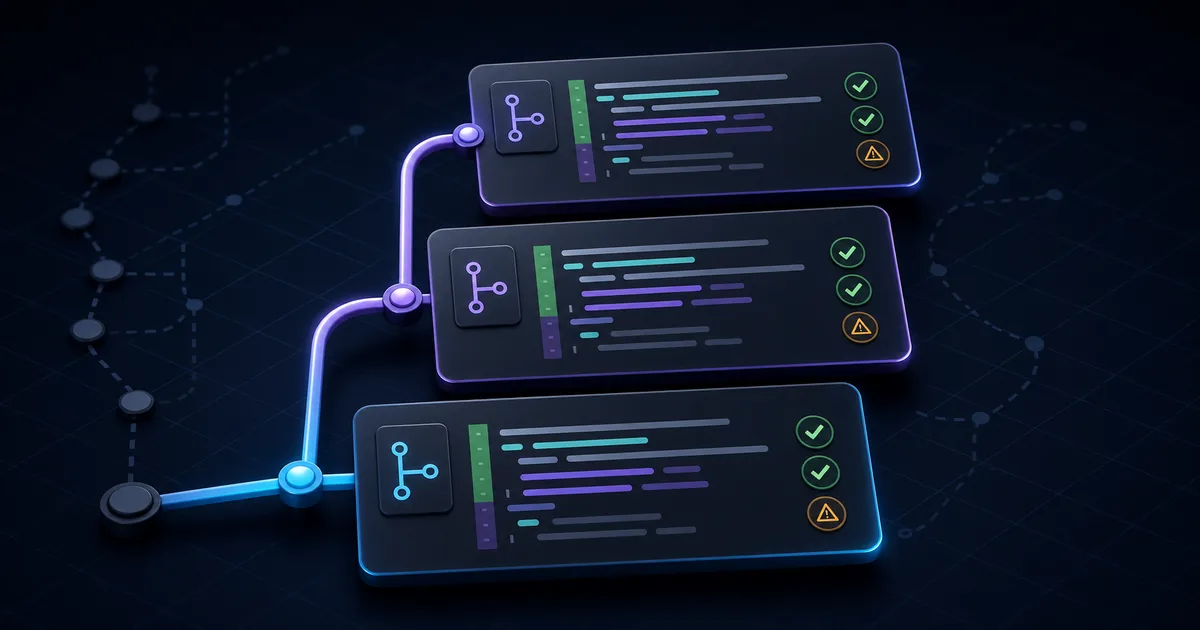
GitHub's native stacked pull requests solve a real problem: a large change can be split into dependent pull requests without forcing reviewers to process one giant diff or authors to manage every rebase manually. The public preview is useful enough for a controlled team pilot, but it is not yet a low-risk default for every repository.
The strongest fit is an internal GitHub repository with high review volume, dependent changes, reliable CI, and developers who already understand rebasing. Open-source projects that receive contributions from forks, teams that require signed commits, and production-critical repositories with little tolerance for rewritten branch history should wait or keep a parallel workflow.
The main risk is not the idea of stacking. It is the blast radius of early automation that can rebase, force-push, synchronize, and merge several dependent branches. The open-source gh-stack client is MIT licensed, but the native stack object, review interface, rule enforcement, and merge behavior live in GitHub. The client can be forked; the complete service cannot be self-hosted from this repository.
This is a researched technical analysis as of August 2, 2026. OpenSourceChoice reviewed the current GitHub documentation, gh-stack v0.1.0 release and repository activity, public security metadata, issue reports, and independent community signals. We did not enable the preview in a production repository, so project claims and user reports are identified as such rather than presented as hands-on findings.
Executive verdict
- Pilot it when dependent work routinely produces large pull requests or blocks authors while lower layers wait for review.
- Do not standardize it yet for fork-based contribution workflows, repositories that forbid unsigned rebases, or teams without a tested recovery path for rewritten branches.
- Budget for more CI, because GitHub evaluates every pull request in a stack as if it targets the stack's final base branch.
- Keep the first pilot small: three or four layers in a non-critical repository, one review policy, one merge method, and a retained backup ref before every rebase.
- Evaluate Git Town or git-spice in parallel if the team wants an open-source local stacking workflow with less dependence on GitHub's native stack object.
Why this matters now
The timing is more substantial than a repository briefly appearing on a trend list.
GitHub released gh-stack v0.1.0 on July 29, 2026. The release added an atomic gh stack merge command and fixed several rebase and trunk-synchronization failures. On July 30, GitHub moved stacked pull requests from private preview to a public preview rolling out to all repositories over several days. Merge-queue support was announced as a progressive rollout over the following weeks.
Independent interest followed the public-preview announcement. A July 30 r/programming discussion attracted sustained technical debate about review size, rebasing, merge queues, and workflow maturity. GitHub Stacked PRs also launched on Product Hunt that week, and github/gh-stack appeared on GitHub's daily Trending list when checked on August 2. Earlier Hacker News and Lobsters discussions around the private preview show that the interest predates the public rollout rather than coming from one promotional post.
The event dates matter. The April private preview is not the current release state; the July 29 CLI release is not the same event as the July 30 public-preview rollout; and public preview still means the behavior is subject to change.
What stacked pull requests actually change
A stack is a linear chain of branches and pull requests:
main
  └─ auth-layer       -> PR 1 targets main
       └─ api-layer   -> PR 2 targets auth-layer
            └─ ui     -> PR 3 targets api-layer
Each pull request shows only the diff between its branch and the layer below it. GitHub adds a stack map to the pull-request interface, evaluates branch protections and CI against the final stack target, and permits contiguous layers to merge from the bottom upward.
The architecture has four relevant parts:
- Standard Git branches and commits. The dependency chain is still represented by branches whose histories build on each other.
- Local
gh-stackmetadata. The CLI stores stack order in.git/gh-stack; it does not commit that file to the repository. - GitHub's stack object. GitHub links the pull requests server-side and exposes membership through the pull-request UI, webhooks, REST API, and GraphQL.
- Rules, Actions, and merge queues. Every layer is checked against the final base branch's requirements. A direct stack merge is atomic; merge queues process layers in order and can split a large stack across consecutive merge groups.
The CLI is optional. Teams can create stacks in the GitHub interface or manage branches with tools such as Jujutsu, Sapling, or Git Town, then link the pull requests on GitHub. gh-stack adds the integrated commands for creating branches, cascading rebases, pushing, submitting, restructuring, syncing, and merging.
What it does not solve
Stacking makes dependencies visible; it does not make poorly separated changes independent.
- A conceptual flaw in the bottom layer can still invalidate the layers above it.
- Reviewers still need an agreed order, ownership model, and response time.
- Rewriting a lower branch can still retrigger CI and complicate review history.
- More pull requests do not reduce the total code or test surface.
- A stack cannot replace feature flags when partially merged code must remain disabled.
- The workflow does not remove the need for small, coherent commits and rollback design.
Current product limits are also concrete. GitHub documents that all branches must live in the same repository, so cross-fork stacks are unsupported. GitHub Desktop is unsupported. Auto-merge is unavailable for stacked pull requests, and the stack must maintain linear history before merging.
Those constraints make the feature a weak default for public open-source contributions, where contributors normally work from forks. They are less restrictive for internal repositories where every author can create branches in the same repository.
The real operational cost
The MIT-licensed CLI has no subscription fee, and GitHub did not announce a separate preview charge. That does not make adoption free.
CI multiplies by layer
GitHub Actions workflows configured for pull requests to main run for every layer because each layer is evaluated as if it targets main. A five-layer stack can therefore trigger the same workflow five times before later rebases and review updates run it again.
GitHub exposes stack size, position, and final base in github.event.pull_request.stack. Teams can use that metadata to keep cheap correctness checks on every layer while reserving expensive end-to-end, packaging, or performance jobs for the top or lowest unmerged layer. That optimization saves compute, but it also creates policy that must be reviewed: skipping the wrong job can allow an intermediate layer to look healthy when it is not deployable.
Rebase work shifts rather than disappears
gh stack rebase cascades changes through the stack. gh stack push uses --force-with-lease after a rebase. GitHub's server-side rebase force-pushes every affected branch and retriggers checks.
Automation removes repetitive commands, but conflict resolution still belongs to the developer. A change near the bottom can require updates to every descendant, invalidate approvals depending on repository policy, and consume more CI than a normal pull request.
Review coordination becomes explicit work
Teams need conventions for:
- maximum stack depth and maximum diff size per layer;
- which reviewers own each layer and who owns the whole stack;
- whether higher layers may be approved before lower architecture is stable;
- how changes to a lower layer are communicated;
- which merge method is allowed;
- when to abandon or flatten a stack;
- how to recover remote-only work before a rebase or prune.
Without those rules, the UI can turn one confusing pull request into several confusing pull requests.
Security and supply-chain boundaries
gh-stack operates through the developer's authenticated GitHub CLI session. Its normal workflow can create branches and pull requests, force-update branches with lease checks, and merge multiple approved pull requests. A compromised extension or overly broad token therefore has meaningful repository-write impact.
The official release process has useful supply-chain controls. The v0.1.0 release commit is shown as verified, release assets publish SHA-256 digests, and the tagged release workflow requests GitHub artifact attestations for precompiled binaries. Teams should still install from the official github/gh-stack repository, record the exact version and asset digest used in the pilot, and avoid upgrading during a test window without reviewing release notes.
The repository's public community profile exposed no SECURITY.md when checked on August 2, and the public repository-advisory endpoint returned no published advisories. That means there was no repository-specific private reporting policy visible through those surfaces; it does not prove the code has no vulnerabilities.
The preview introduces two policy-sensitive behaviors:
- Unsigned server rebases. GitHub documents that commits created by a server-side stack rebase are not signed. Repositories that require signed commits should perform the cascading rebase locally with the team's signing configuration.
- Multi-PR merge authority. Selecting a higher pull request can merge it and every unmerged layer below it. Branch protection still applies, but reviewers and automation must understand that one merge action can land a group.
Back up stack tips under temporary refs before a high-risk rebase, prohibit automatic pruning during the pilot, and test restoration from the reflog and remote refs. Treat zero lost commits as an adoption gate, not as a hopeful outcome.
Privacy and data flow
The local metadata file stays inside .git, but the useful collaboration state is hosted by GitHub:
local commits and .git/gh-stack
        -> authenticated gh-stack commands
        -> GitHub branches and pull requests
        -> GitHub stack object, webhooks, APIs, checks, and merge queue
For a team already using GitHub pull requests, stacking does not introduce a new code host. It does increase the number of branches, pull requests, events, and CI records sent to that host. Branch names, pull-request descriptions, logs, and workflow output remain part of the normal GitHub data boundary.
The optional agent skill is a separate decision. Native stacked pull requests do not require an AI agent. If an agent is allowed to split or submit a stack, its model provider, repository permissions, prompt logs, and approval boundary must be assessed independently. Do not treat an open-source CLI as proof that the connected agent workflow is local or private.
Maturity: active, useful, and visibly early
Version 0.1.0 is the latest stable CLI release observed on August 2. It was published one day before the public-preview announcement and fixed three consequential classes of failure: stale-trunk rebases, duplicate history after amended parent commits, and incorrect default-branch handling. Those fixes are reassuring evidence of active maintenance and simultaneous evidence that the workflow is young.
GitHub's public API returned 24 commits with author dates since July 1, 56 open issues, and three open pull requests when checked. Nineteen of those commits used the same maintainer name, while four were Dependabot updates and one was attributed to Copilot. This is a limited activity sample, not a formal bus-factor calculation, but it shows that implementation knowledge is concentrated.
Recent issue reports deserve pilot tests rather than automatic acceptance as universal defects. Reports opened around the public rollout describe sync rebasing in ways that can disrupt review history, a push path that may mishandle remote-only commits, merge-queue integration failures, and stacks that appeared mergeable but could not merge. The issue queue is active, and maintainers had already fixed related rebase failures in v0.1.0. A production decision should depend on reproducing the team's own branch, approval, signature, and merge-queue policies.
Where adoption makes sense
Strong pilot candidates
- internal monorepos where one feature crosses schema, backend, API, and UI ownership;
- teams whose normal pull requests regularly exceed their reviewable size target;
- high-throughput repositories where authors currently wait for dependent work to merge;
- organizations already using GitHub branch protection and merge queues;
- supervised agent workflows that need one reviewable unit per dependent task.
Poor candidates today
- public projects whose contributors work primarily from forks;
- small teams whose changes are already independent and quickly reviewed;
- repositories that prohibit rewritten branch history;
- environments that require every server-created commit to retain a developer signature;
- teams unable to absorb multiplied CI usage;
- organizations seeking a self-hosted or forge-portable review data plane.
Alternatives to evaluate in parallel
| Alternative | Better fit | Main trade-off |
|---|---|---|
| Normal GitHub PRs with disciplined commits | Independent changes and short review queues | Dependent branches remain manual and lack a native stack map |
| Git Town | Open-source, forge-compatible branch automation with stacked changes | GitHub-native stack linking and merge semantics remain a separate layer |
| git-spice | A mature open-source CLI focused on stacked branches and reviews | Another local workflow to learn; native GitHub behavior still depends on GitHub |
| Jujutsu plus GitHub stacks | Developers who prefer change IDs and automatic local rebasing | Requires a different VCS mental model and GitHub bookmarks or branches per PR |
| Graphite | Teams prioritizing a polished hosted stacked-review workflow | Proprietary service, additional data boundary, and possible subscription cost |
| Gerrit | Organizations that want patch-series-native review and operate their own review system | Much larger migration, administration, and workflow change |
Git Town is the most useful parallel evaluation for teams that want to preserve standard Git branches and portability. Gerrit is the stronger comparison when the real requirement is a self-hosted review system rather than a GitHub enhancement.
A controlled two-week pilot
1. Choose one representative change
Use a non-critical internal repository and a feature with three or four genuinely dependent layers. Avoid authentication, billing, deployment credentials, and emergency fixes for the first stack.
2. Freeze the tool and policy
Install from the official repository, record v0.1.0 and its release digest, choose one merge method, disable automatic pruning, and require a clean working tree before every stack operation. Document who can merge the stack.
3. Define the layers before coding
Each layer must have one purpose, tests that can run at that layer, a named reviewer, and a clear reason it depends on the layer below. If a layer cannot be explained independently, combine it or redesign the dependency.
4. Set a CI budget
Run fast correctness and security checks on every layer. Run expensive end-to-end and performance suites at the top, and prove that this optimization cannot hide an invalid intermediate merge. Record total workflow runs and runner minutes.
5. Exercise the failure paths
Amend the bottom layer, perform a local signed cascading rebase, create a deliberate conflict, recover from an aborted rebase, simulate a remote-only commit, partially merge the stack, and restore a saved tip. Repeat with the repository's real branch-protection and merge-queue settings.
6. Compare measurable outcomes
Use a comparable normal pull request as the baseline. An example adoption gate is:
- at least 20% lower median time from review request to approval;
- no more than 15% additional CI minutes after workflow optimization;
- zero lost commits, unexpected force updates, or invalidated required signatures;
- every layer independently understandable to its assigned reviewer;
- one successful partial merge and one full-stack merge with a proven rollback;
- no unresolved preview bug that affects the repository's required policy.
These percentages are an OpenSourceChoice pilot threshold, not a GitHub benchmark. Replace them before the pilot if the team's cost and latency budgets require stricter values, but do not decide after seeing the results.
OpenSourceChoice assessment
- Best for: GitHub-centric teams with large dependent changes and strong Git/review discipline.
- Not for: fork-heavy open-source contribution, immutable-history policies, or teams seeking a self-hosted review platform.
- Why now: the feature entered public preview on July 30, immediately after
gh-stackv0.1.0, with multiple independent adoption and debate signals. - Real cost: multiplied CI, rebase and review coordination, policy work, and deeper GitHub dependence.
- Main risk: early automation can rewrite or merge several dependent branches at once.
- Production gate: prove signed local rebases, remote-work preservation, branch protections, CI budgeting, partial merge, and rollback in a disposable pilot.
- Parallel alternative: Git Town for portable branch automation; Gerrit when self-hosted patch-series review is the actual requirement.
- Recommendation: pilot GitHub Stacked PRs in one internal repository, but keep ordinary pull requests as the default until the preview survives the team's real merge and recovery policies.
Sources
Primary sources were accessed on August 2, 2026 unless another date is stated.
- Stacked pull requests are now in public preview — GitHub Changelog; published July 30, 2026; rollout state, supported surfaces, and progressive merge-queue availability.
- About stacked pull requests — GitHub Docs; current public-preview architecture, same-repository restriction, GitHub Desktop limit, APIs, rules, and merge behavior.
- Managing stacked pull requests — GitHub Docs; local and server rebases, force-push behavior, unsigned server-created commits, restructuring, and synchronization.
- Merging stacked pull requests — GitHub Docs; bottom-up merge requirements, merge queues, and current auto-merge limitation.
- Optimizing CI for stacked pull requests — GitHub Docs; per-layer workflow execution and stack metadata for CI controls.
gh-stackv0.1.0 release — GitHub; published July 29, 2026; latest stable version observed August 2, new merge command, fixed rebase behavior, binaries, digests, and release provenance.gh-stackrepository and MIT license at v0.1.0 — GitHub; source, installation, local metadata, activity, license, issues, and pull requests.- Release workflow at v0.1.0 — GitHub; permissions and generated artifact attestations for precompiled releases.
syncreview-history report #354, remote-only commit report #380, and merge-queue report #268 — upstream issue reports observed open August 2; evidence of scenarios to reproduce, not independently confirmed universal failures.gh-stacksecurity page — GitHub; public security-policy and advisory surface checked August 2.- Git Town, git-spice, Jujutsu, and Gerrit Code Review — official project sources for alternatives evaluated in parallel.
Discovery and interest signals, not used as sole evidence for technical claims:
- GitHub Trending —
github/gh-stackappeared on the daily list when observed August 2, 2026. - Public-preview discussion on
r/programming— July 30, 2026; independent debate about review value, rebasing, merge queues, and preview maturity. - GitHub Stacked PRs on Product Hunt — launch-week product and adoption signal observed August 2, not technical proof.
- GitHub Stacked PRs on Hacker News and Lobsters — independent discussion around the earlier private preview; historical interest rather than evidence of the July public rollout.
All adoption thresholds, risk weighting, and recommendations are OpenSourceChoice editorial analysis.
Build a stack for this use case.
Answer nine practical questions and compare three transparent architectures with costs, free limits, lock-in, and migration paths.
Build my stack