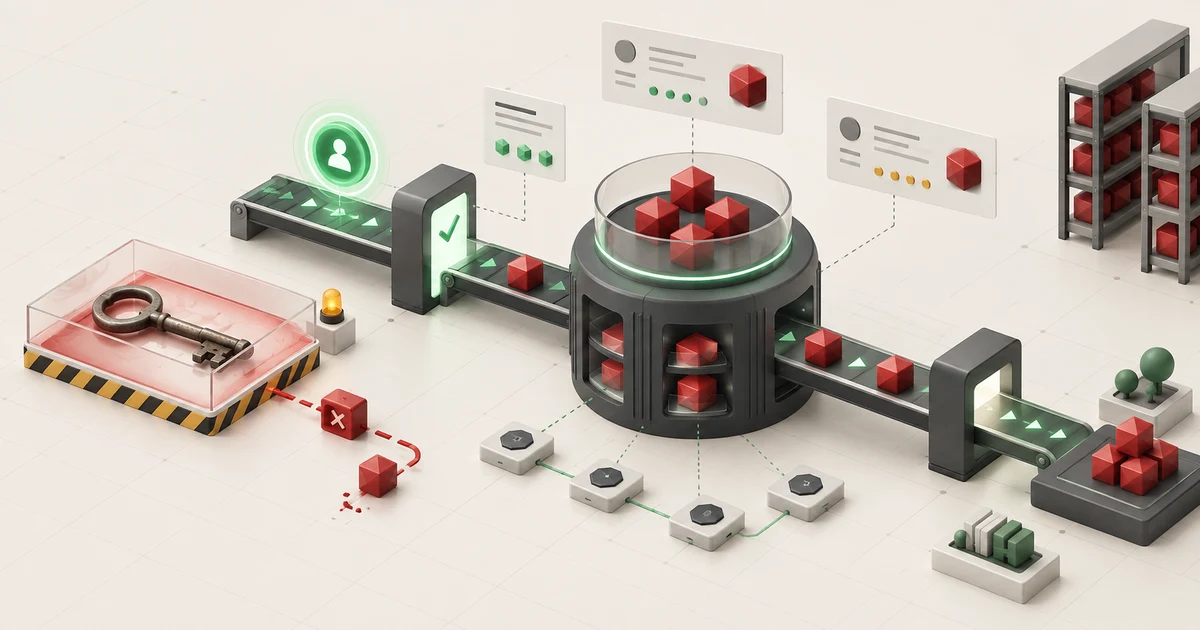

The Arch User Repository is still useful. It is not safe to treat it like an official binary repository.
That distinction became urgent again on July 31, when the Arch Linux DevOps team disabled package adoption after another influx of malicious adoptions and follow-up commits. The immediate control closes the abused takeover path. It does not verify existing package recipes, authenticate every Git commit, prove that upstream downloads are benign, or make unattended AUR upgrades suitable for production.
OpenSourceChoice verdict: experienced Arch users can keep a small, deliberate AUR footprint if they review every changed file, verify upstream identity, build away from valuable user data, and retain a tested replacement or rollback path. Beginners, unmanaged desktop fleets, production servers, and machines holding high-value credentials should prefer official Arch packages, a verified upstream distribution channel, or an internally reviewed repository.
Do not ask only whether a package was safe when first installed. The adoption incidents show why the relevant question is whether the exact maintainer, recipe, source, build, and package being installed today are still trustworthy.
Methodology: This is a researched security and adoption analysis based on the Arch DevOps announcements, current ArchWiki guidance, aurweb source and issue state, Arch package-tool documentation, and independent community signals observed on August 1, 2026. OpenSourceChoice did not execute the reported payloads, perform malware reverse engineering, or audit every affected package. Package lists and payload claims from community reports are treated as incident context, not independent findings.
Why this matters now
The July event is not a recycled headline about June.
- Arch published a project-wide warning on June 12 after a high volume of malicious package adoptions and updates.
- New AUR account registration was later disabled, then reopened on July 13 with disposable-email rejection, mandatory email verification, and a cooldown around email changes.
- A new cluster of suspicious adoption activity and package changes was reported on the official
aur-generallist on July 30 and 31. - On July 31, the Arch DevOps team disabled package adoption and said it would issue a follow-up when the situation was under control. No follow-up reopening notice was present when this article was prepared on August 1.
- The response reached independent audiences: a same-day
r/archlinuxthread received substantial discussion, the incident was covered by LWN, and the LWN report appeared on the Lobsters front page.
That is more than a single viral post. It is a repeated technical incident, an operational restriction by the project, active code changes, and independent user concern.
The timing also matters because the AUR is often presented as a convenience feature of the Arch ecosystem. A one-command helper can make an unofficial build recipe feel indistinguishable from pacman -S. The trust models are not equivalent, even when the command-line experience looks similar.
What happened—and what is verified
The most defensible incident timeline comes from Arch-controlled sources.
| Date | Verified event | What it means |
|---|---|---|
| June 12 | Arch warned of malicious package adoptions and updates | The project acknowledged an active AUR supply-chain problem |
| June 15 | New AUR registration was disabled | DevOps restricted account creation during cleanup |
| July 13 | Registration reopened with additional account controls | The account-creation path was hardened, not the entire package trust chain |
| July 30–31 | Mailing-list participants reported a new wave of suspicious adopted packages and embedded executables | Community and maintainer reports showed renewed activity; OpenSourceChoice did not independently validate every package or payload |
| July 31 | Arch DevOps disabled package adoption | Orphaned packages could no longer be taken over through the normal adoption flow while the incident was handled |
| July 30–31 | aurweb changes added Package Maintainer review for adoption and rejected pushes to orphan package bases | The source tree moved toward a reviewed handoff model after the latest tagged release |
The official notice deliberately does not publish a final affected-package count or a complete forensic report. This article therefore does not repeat precise totals as established fact.
The key verified mechanism is simpler: malicious actors used the legitimate adoption path for orphaned packages, then pushed harmful changes. A familiar package name and old Git history were not proof that the new maintainer or update deserved inherited trust.
What AUR actually provides
AUR is a community collection of packaging recipes, not a repository of Arch-reviewed binaries.
The aurweb platform provides:
- a web interface for discovering package recipes;
- an SSH and Git interface for submitting updates;
- comments, votes, flags, and package requests;
- administrative controls for Package Maintainers and developers.
An end-user installation crosses several separate trust boundaries:
- The user or helper retrieves a Git repository containing
PKGBUILDand related files. makepkginterprets the recipe, downloads declared sources, runs preparation and build steps, and creates a package.pacmaninstalls the resulting package, including any package install scriptlets.- The installed program then runs with whatever files, network access, devices, and credentials the user grants it.
The AUR does not promise that a recipe has been thoroughly vetted. Arch's own documentation calls AUR content unofficial, user-produced, and used at the user's risk. It explicitly tells users to inspect PKGBUILD, .install, patches, systemd units, and every other file before building.
This is why “the checksum passed” is not a complete security argument. A checksum proves that the downloaded file matches the value selected in the recipe. If an attacker changed both the source and the checksum, integrity verification can succeed while authenticity and intent have already failed. A valid upstream PGP signature or independently verified release digest is stronger because it connects the source to a separate trust root.
Current project state: active, but the fix is newer than the latest tag
The infrastructure is not abandoned.
The latest aurweb tag observed on August 1 was v6.4.2, committed July 26. The project uses Python, FastAPI, Git, SSH, MariaDB, and optional Redis; its repository includes a documented Docker development path. The code is licensed under GPL-2.0-only.
Important adoption controls landed on master after v6.4.2:
- a July 30 commit requires Package Maintainer review for adoption requests;
- follow-up fixes assign accepted adoption requests to the requester correctly;
- a July 31 commit rejects pushes to orphan package bases.
Those commits are concrete evidence of active maintenance. They should not be described as part of v6.4.2, and a source commit is not proof that every production AUR node has deployed the same code. The operational fact is narrower: DevOps announced that adoption was disabled. The durable reviewed-adoption design still needs release, deployment, abuse testing, and an official reopening notice.
The public tracker also showed unresolved proposals created after the June incident, including authenticated commit identity, a “report as malicious” action, package quarantine, and special handling for high-value packages. Open issues are not proof that the current system has no controls. They show that several important defenses were still design work rather than completed guarantees on August 1.
The aurweb source tree had no repository-level SECURITY.md or advisory document when checked. Current incident communication and reporting instead run through Arch news, the AUR interface, Package Maintainers, and the official mailing lists. The Arch security tracker remains valuable for official repository packages, but it is not a universal advisory feed for community AUR recipes or everything those recipes download.
The real threat model
The adoption route was the immediate incident vector, but it is not the only path that matters.
1. Recipe compromise
A malicious PKGBUILD, .install file, patch, bundled executable, or helper script can run commands during build or installation. Reviewing only the package name, version, and source URL misses most of this surface.
2. Maintainer transition
An orphaned package can preserve years of benign history while control changes. The latest diff and current maintainer matter more than the age of the package page.
3. Maintainer account or workstation compromise
Reviewing the adoption event does not prevent an established maintainer account, token, or workstation from being compromised later. Signed commits can improve attribution, but they do not prove that a signed change is safe.
4. Upstream compromise
A clean recipe can still retrieve a compromised upstream release, mutable branch, replaced archive, poisoned dependency, or hostile install script. AUR review and upstream security are different controls.
5. Build-host exposure
makepkg runs as the current user. A hostile build step can target SSH keys, browser profiles, cloud credentials, source checkouts, mounted shares, agent sockets, or other readable files before a package exists. Building in a clean chroot reduces this host exposure, but it does not prove the produced package is safe to install.
6. Installed-package privilege
The package installation phase can execute scriptlets through pacman, and the installed software may later run as the user, a service account, or root. Build isolation limits only part of the chain.
7. Automation blindness
An AUR helper may automate discovery, dependency resolution, retrieval, building, and upgrades. ArchWiki distinguishes helpers that offer file review and diff views from tools that may source recipes before inspection. Convenience can remove the pause where a suspicious maintainer, new file, or source-domain change would otherwise be noticed.
What the new controls fix—and what they do not
Requiring Package Maintainer review for adoption is a meaningful improvement. It converts an immediate anonymous handoff into a request that can be inspected. Rejecting pushes to orphan package bases also blocks updates during the period when no accountable maintainer exists.
These changes can reduce automated orphan takeovers. They do not create a complete package-review service.
| Control | Helps with | Does not prove |
|---|---|---|
| Disable direct adoption | Stops the currently abused takeover path | Existing packages and maintainers are benign |
| Package Maintainer review | Adds human judgment to ownership transfer | Every later commit or upstream source is safe |
| Email verification and disposable-email blocking | Raises the cost of disposable account creation | One person owns only one account or has good intent |
| Signed Git commits | Improves attribution and detects simple author spoofing | The signer, workstation, recipe, or payload is trustworthy |
| Checksums | Detects source changes relative to the recipe | The recipe selected an authentic or safe source |
| Clean-chroot build | Limits some build-time access to the host | The resulting package is safe to install or run |
| Malware scanning | Finds known patterns and suspicious structure | Novel, delayed, obfuscated, or upstream malware is absent |
The editorial conclusion is not that these controls are pointless. It is that they must be layered, and the user still owns the final package decision.
Is AUR appropriate for your machine?
A reasonable fit
AUR remains defensible for:
- an experienced individual with a small package set and time to review updates;
- a development machine that isolates builds and keeps recoverable credentials elsewhere;
- software whose official upstream identity and releases can be verified independently;
- non-critical tools with a clear uninstall, rollback, or replacement path;
- a team that converts reviewed recipes into internally signed packages before fleet distribution.
A poor fit
AUR is a poor default for:
- beginners who copy helper commands without understanding package recipes;
- production servers where unattended updates are expected;
- privileged infrastructure, signing machines, password vault hosts, or systems holding broad cloud and SSH access;
- managed fleets without a central review and artifact-promotion process;
- packages whose upstream cannot be identified, whose sources are mutable, or whose update adds unexplained binaries;
- any workload where nobody is accountable for security notices, rebuilds, and recovery.
The number of AUR packages matters less than their privilege and exposure. One network-facing service or credential-handling tool can be riskier than ten isolated desktop themes.
A safer operating baseline
1. Inventory foreign packages
Start with:
pacman -Qm
The --foreign filter lists installed packages absent from the configured sync databases. That includes AUR-built packages but can also include manually installed local packages, so classify the output rather than labeling every row “AUR.” Record the package base, current maintainer, upstream repository, install reason, and replacement channel.
2. Freeze unattended AUR upgrades
Do not run blind batch upgrades during an active incident. Continue applying official Arch security updates, then handle foreign packages separately. Avoid a permanent partial-upgrade state; the goal is controlled review, not indefinitely freezing the whole system.
3. Review the complete Git diff
For each update, inspect every changed file, not only PKGBUILD:
git status --short
git log --show-signature --oneline -5
git diff @~..@
Pay special attention to:
- maintainer and commit-identity changes;
- new
.install, service, timer, desktop, patch, or executable files; curl,wget,npm,pip, shell-evaluation, and privilege-escalation behavior;- source domains, repository owners, branches, tags, and release assets;
- skipped checksums or skipped PGP verification;
- new network listeners, auto-start services, and post-install actions.
A signed commit is useful evidence, not an approval stamp. Verify that the key belongs to the maintainer you intended to trust and that the diff itself is reasonable.
4. Verify sources independently
Open the upstream release page separately. Compare the version, asset name, digest, signature, and repository owner. Prefer immutable tagged archives and upstream signatures over mutable branches or opaque third-party binaries.
makepkg --verifysource downloads sources and runs the configured integrity checks without extracting or building them. Use it as one gate, not the final verdict.
5. Build in a clean environment
Arch's pkgctl build uses a clean chroot and supports recreating the environment before a build. This reduces access to the user's home directory and prevents accidental dependency leakage from the host.
Do not mount SSH agents, browser profiles, cloud configuration, source repositories, or broad home directories into the build environment. Restrict network egress when the recipe does not need it. Remember that installing and running the output remain separate trust decisions.
6. Inspect the produced package
Before installation, list its files, inspect scriptlets and service units, and run package sanity checks. Look for unexpected setuid files, writable service paths, bundled binaries, auto-start entries, and network configuration. For high-impact tools, compare the packaged files with an independently built or upstream-published artifact.
7. Promote, sign, and retain artifacts
Teams should not repeat an Internet-facing AUR build on every endpoint. Review once in CI, store the exact recipe commit and source digests, sign the resulting package with an organizational key, publish it to a restricted internal repository, and retain the previous known-good artifact.
That approach adds infrastructure and operator time. It also creates a review record, a rollback path, and one artifact shared by the fleet.
8. Monitor the right channels
Follow aur-general, the package's AUR comments and Git history, upstream releases, and upstream security notices. The official Arch security tracker covers official packages; it is not a complete advisory feed for arbitrary AUR recipes and their upstreams.
What to do if a suspicious package was installed
Do not assume uninstalling it reverses every action already performed.
- Disconnect or isolate the system if active compromise is plausible.
- Preserve the AUR Git commit, package file, logs, process list, network state, and relevant timestamps before cleanup.
- Identify which user built the package and what credentials or files that account could read.
- Rotate SSH keys, API tokens, browser sessions, password-vault sessions, and signing credentials from a separate trusted machine when exposure is possible.
- Review persistence: systemd units, timers, cron entries, shell startup files, user services, modified binaries, and new accounts.
- Compare important files with trusted packages or backups.
- Reinstall from trusted media when integrity cannot be re-established confidently.
- Report the package and commit through the current Arch channels without publishing live secrets or unsafe payload links.
Community malware scanners can help collect indicators. They do not provide a clean bill of health, especially when the tool or result is based on heuristic or model-generated analysis.
Privacy and data-flow consequences
The AUR website mainly distributes recipes and metadata. The larger privacy boundary is the local build and installed program.
A recipe executed as a normal desktop user may read developer credentials, document directories, browser state, clipboard-accessible services, local sockets, and mounted network storage. It can also make outbound requests that reveal IP address, package selection, host details, or stolen data. Running makepkg as non-root prevents one class of direct system modification, but it does not protect user-readable secrets.
For a team, draw the flow explicitly:
AUR Git recipe -> external source hosts -> isolated builder -> internal package repository -> endpoint
Every arrow needs an owner, an authenticity check, logging, and a revocation path. If the builder can reach production secrets or the endpoint installs directly from an unreviewed recipe, the boundary is incomplete.
License, portability, and lock-in
aurweb itself is GPL-2.0-only. Its source, schema, Git interface, and deployment documentation are public, so the platform is inspectable and forkable. That does not determine the license of each AUR recipe or the software it retrieves. Operators must review the upstream license and redistribution rights package by package.
The recipe format improves portability at the source level: a PKGBUILD is text, package histories are Git repositories, and produced packages can be stored in a normal pacman repository. Operational lock-in remains substantial because recipes assume Arch tooling, package names, dependency versions, filesystem conventions, and a rolling-release environment.
An exit plan should map each foreign package to one of:
- an official Arch package;
- a verified upstream Flatpak for desktop applications;
- an upstream signed release or container with a documented update path;
- a locally maintained package in an internal repository;
- removal when the software is no longer necessary.
Switching channel is not automatically safer. A verified Flatpak improves publisher identity and sandboxing signals, but permissions and update trust still require review. An upstream curl | sh installer may remove the AUR middleman while adding a less inspectable update path.
The real operating cost
AUR has no subscription fee. Safe use is not free.
For one user, the cost is review time, build CPU and storage, update monitoring, credential hygiene, and occasional troubleshooting when official libraries change. For a team, add isolated builders, package signing, an internal repository, source retention, vulnerability monitoring, test machines, promotion records, and incident response.
The cheapest workflow—letting every endpoint run an unattended helper—is also the workflow that discards most of the AUR's intended review boundary.
Alternatives to evaluate in parallel
| Alternative | Better fit | Main trade-off |
|---|---|---|
| Official Arch repositories | General system packages and services | Smaller selection than AUR; package inclusion is curated |
| Verified Flathub application | Desktop apps where publisher identity and sandboxing help | Larger runtimes, permission review, and a separate update channel |
| Upstream signed release | Tools with mature, verifiable releases | Manual lifecycle integration and possible filesystem drift |
| Internal pacman repository | Teams and production fleets | Requires builders, signing, storage, testing, and ownership |
| Another distribution's official repository | Users who prioritize curated package availability over Arch flexibility | Migration cost and different release cadence |
The parallel alternative should match the package. Flatpak is not a replacement for a kernel module, and an upstream tarball is not automatically a maintainable replacement for a system service.
A seven-day evaluation plan
Use a disposable VM or non-sensitive test machine.
Day 1: inventory. Run pacman -Qm, identify true AUR packages, and record their privileges, upstreams, maintainers, and business importance.
Day 2: reduce. Replace or remove packages available through official repositories or verified upstream channels. Set a maximum justified AUR footprint.
Day 3: review workflow. Configure the chosen helper to show file diffs before sourcing or building. Prove that a maintainer change, new .install file, and new bundled binary cannot pass without a visible pause.
Day 4: isolated build. Build one representative package in a clean chroot with no home-directory mounts or credential agents. Record exact recipe commit and source digests.
Day 5: artifact inspection. Examine the package file list, scriptlets, services, permissions, dependencies, and outbound behavior in the VM.
Day 6: rollback. Install the reviewed package, then downgrade to the retained previous artifact and verify that the application and system still work.
Day 7: incident drill. Assume the builder account was exposed. Practice isolating the machine, identifying readable credentials, rotating one test credential, and rebuilding from trusted media.
Adopt the workflow only if all gates pass:
- every foreign package has an owner and a justified source channel;
- updates cannot proceed without a complete diff review;
- builds cannot read valuable user or production credentials;
- sources have an independent authenticity check where available;
- a previous package artifact and tested rollback exist;
- security notices are assigned to a person, not an unattended script;
- high-impact packages are promoted through an internal repository or moved off AUR.
OpenSourceChoice assessment
- Best for: experienced Arch users and teams prepared to own package review and builds.
- Not for: beginners, blind batch upgrades, production servers, or credential-rich hosts without isolation.
- Why now: Arch disabled package adoption on July 31 after a fresh malicious-adoption wave, while reviewed-adoption controls landed after the latest aurweb tag.
- Real cost: human review and reproducible package operations, not an AUR subscription.
- Main risk: a familiar package name can deliver a new recipe, source, or maintainer into a high-trust local build context.
- Production gate: isolate builds, verify sources, sign promoted artifacts, retain rollback, and remove direct endpoint builds.
- Parallel alternative: official Arch packages first; verified Flatpak, upstream releases, or an internal pacman repository depending on the workload.
- Recommendation: keep AUR use small and deliberate. If the machine cannot tolerate a hostile user-level build script, do not build AUR packages on it.
Sources
Primary sources:
- AUR packages adoption disabled — Arch Linux DevOps team; July 31, 2026; current operational restriction.
- Active AUR malicious packages incident — Arch Linux; published June 12, 2026; original project warning and user guidance.
- AUR registration reopened — Arch Linux DevOps team; July 13, 2026; account-registration hardening and reopening notice.
- Package Maintainer review for package adoption — aurweb commit; July 30, 2026; post-tag adoption-review design.
- Reject pushes to orphan package bases — aurweb commit; July 31, 2026; post-tag push restriction.
- aurweb v6.4.2 tag — Arch Linux aurweb; tagged July 26, 2026; latest tagged version observed August 1.
- aurweb README — Arch Linux aurweb; platform components and interfaces at v6.4.2.
- aurweb license metadata — Arch Linux aurweb; GPL-2.0-only metadata at v6.4.2.
- Avoid spoofed email address in commits — aurweb issue; opened June 14, 2026; identity-control proposal observed open August 1.
- Add “report as malicious” action — aurweb issue; opened June 16, 2026; reporting proposal observed open August 1.
- Quarantine package — aurweb issue; opened June 21, 2026; quarantine proposal observed open August 1.
- Arch User Repository — ArchWiki; current manual workflow, trust warning, Git review, and package responsibility; accessed August 1, 2026.
- AUR helpers — ArchWiki; current support warning and file-review/diff criteria; accessed August 1, 2026.
- makepkg manual — Arch Linux manual pages; Pacman 7.1.0 documentation observed August 1, 2026.
- pkgctl build manual — Arch Linux manual pages; clean-chroot build behavior observed August 1, 2026.
- pacman manual — Arch Linux manual pages; foreign-package inventory and package operations observed August 1, 2026.
- Arch Linux security tracker — Arch Linux; official package advisory and remediation tracker accessed August 1, 2026.
- Flathub verified apps — Flathub documentation; publisher-verification alternative accessed August 1, 2026.
Trend and independent context:
- New AUR malware wave discussion —
r/archlinux; July 30, 2026; discovery and community-risk signal, not primary forensic evidence. - AUR adoption-disabled discussion —
r/archlinux; July 31, 2026; independent user-interest and operational-impact signal. - Arch Linux disables AUR package adoption — LWN; July 31, 2026; independent incident context linking back to Arch sources.
- Lobsters discussion — Lobsters; July 31, 2026; independent discovery signal.
All recommendations and trade-off conclusions are OpenSourceChoice editorial analysis. Community reports are not presented as a substitute for Arch announcements, source history, or independent malware analysis.
Build a stack for this use case.
Answer nine practical questions and compare three transparent architectures with costs, free limits, lock-in, and migration paths.
Build my stack