GitHub remains the default forge for millions of developers, but it is not the only durable option. Teams leave for cost control, data residency, independence from a single vendor, compliance constraints, or a forge that matches how they already ship software.
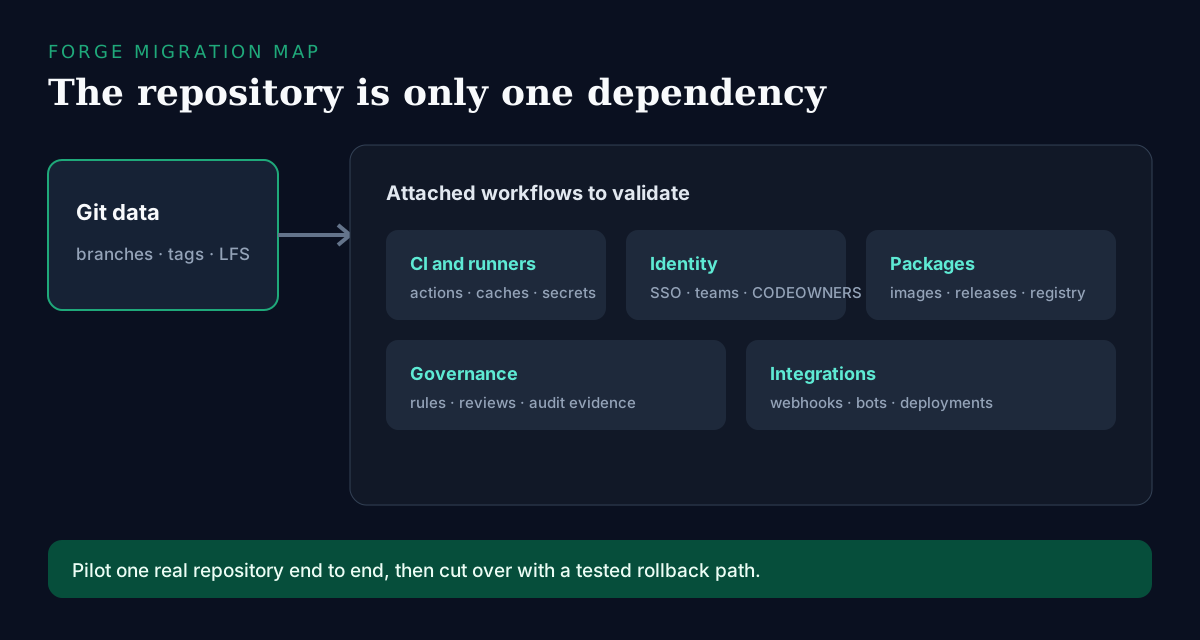
The common failure mode is migrating on feature checklists alone: a team falls in love with a forge's UI, moves fifty repositories, and only then discovers that CI runner capacity, secrets management, or SSO group mapping does not survive the move. The repositories themselves are the easy part—git clone --mirror works everywhere. Everything attached to them is where migrations stall.
This guide compares twelve practical GitHub alternatives across managed platforms and self-hosted forges. Before reading the profiles, inventory what you actually depend on today: Actions workflows, branch protection, CODEOWNERS, package registries, and identity mappings. Match control, CI/CD depth, compliance needs, and day-to-day developer experience against that inventory—not star counts alone.
Key takeaways
- GitLab is the strongest all-in-one DevSecOps default when you want merge requests, pipelines, and policy in one product.
- Codeberg, Gitea, and Forgejo win when you want FOSS governance or low-ops private Git without enterprise sprawl.
- Bitbucket and Azure DevOps Repos fit best when Jira or Microsoft identity already define your toolchain.
- Decide SaaS vs self-hosted first—ops cost and data residency usually beat feature checklists.
- The hard part of leaving GitHub is rarely the repos: it is CI workflows, secrets, registries, and identity mapping.
- Pilot one realistic repo end-to-end (CI, secrets, CODEOWNERS) before an org-wide cutover, and keep a documented rollback path.
How to choose a GitHub alternative
- Decide whether you need SaaS convenience or infrastructure you operate yourself.
- List must-have integrations: CI/CD, issue tracking, package registry, identity provider.
- Check license and governance if the forge software itself must stay open.
- Estimate total cost: seats, runners, storage, and operator time—not only the free tier.
- Pilot one realistic repository migration before committing the org, including CI and CODEOWNERS.
- Weigh community and hiring signals: a forge your contributors already know lowers onboarding friction.
- Confirm the exit path from the new forge too—portable CI definitions and mirrored repos keep you honest.
- Map your implementation language and packaging needs to catalog stack pages before shortlisting.
Quick comparison
| Tool | Best for | Deployment | Notes |
|---|---|---|---|
| GitLab | All-in-one DevSecOps | SaaS / self-managed | MRs, pipelines, and security in one surface; compliance features sit in paid tiers |
| Bitbucket | Jira-centric teams | Cloud / Data Center | Tight issue-to-branch-to-deploy traceability; weaker outside the Atlassian suite |
| Azure DevOps Repos | Microsoft enterprises | Azure SaaS | Entra ID governance and Azure cohesion; stable rather than fast-moving |
| SourceHut | Unix/email workflows | Hosted / self-hostable | Text-first, email-driven forge; pay-what-you-can, no PR-style web UI |
| Codeberg | Public FOSS hosting | Hosted (EU) | Non-profit Forgejo instance; donation-funded, best for public projects |
| Gitea | Lightweight private Git | Self-hosted / cloud | Runs on tiny VMs; Gitea Actions covers common CI patterns |
| Forgejo | Community-governed forge | Self-managed | Gitea soft fork with LTS releases and Codeberg e.V. governance |
| Launchpad | Ubuntu packaging | Hosted SaaS | Unmatched for PPAs and translations; dated outside Ubuntu workflows |
| SourceForge | Binary distribution | Hosted | Strong download mirroring; weak CI/CD—pair with a modern forge |
| GitBucket | JVM shops | Self-hosted | GitHub-like UI on the JVM; plugin ecosystem, external CI needed |
| RhodeCode | Mixed VCS enterprises | Self-managed | Git + Hg + SVN with unified ACLs and audit trails |
| OneDev | Compact self-hosted DevOps | Self-hosted | Git, CI, kanban, and packages in one compact install |
GitLab
 GitLab
Open in catalogAn all-in-one DevSecOps platform that covers planning, source control, CI/CD, security scanning, and monitoring in a single product surface. Available as SaaS and self-managed. Especially strong when you want merge requests, pipelines, and policy controls without stitching five vendors together. The trade-off is surface area: self-managed instances demand real upgrade discipline, and the most valuable security and compliance features live in paid tiers. Choose GitLab when consolidating the toolchain matters more than a minimal footprint.
- Best for
- Enterprise teams, regulated orgs that need self-hosting, and groups that want one toolchain instead of many point tools.
- Deployment
- SaaS, self-managed, or dedicated single-tenant instances.
- Pricing
- Free tier for core features; Premium and Ultimate add security, compliance, and planning capabilities (open-core model).
- Unique
- Unified application model that reduces tool sprawl across the software lifecycle.
If your delivery stack already centers on containers and cluster workflows, validate GitLab Runner capacity against your Docker/Kubernetes footprint before migrating every pipeline.
Bitbucket
 Bitbucket
Git hosting with built-in Pipelines CI/CD and deep Jira/Confluence integration. Strong when project management and code already live in the Atlassian suite, and when issue-to-branch traceability is a procurement requirement. Its limits show outside that suite: Pipelines is less flexible than GitHub Actions for complex matrix builds, and the third-party ecosystem is smaller. Choose Bitbucket when Jira traceability is a hard requirement—not as standalone Git hosting.
- Best for
- SMB and mid-market teams invested in Jira, plus teams that want tight issue-to-branch traceability.
- Deployment
- Cloud SaaS and Bitbucket Data Center (self-managed).
- Pricing
- Free tier for small teams with storage and build limits; Standard and Premium unlock advanced controls.
- Unique
- Native Jira linkage from issue creation through deployment visibility.
Azure DevOps Repos
Azure DevOps Repos
Microsoft’s Git hosting inside Azure DevOps, alongside Boards, Pipelines, and Artifacts. Best when identity and cloud already sit on Entra ID and Azure, and when audit trails must align with the rest of the Microsoft estate. Be aware that Microsoft’s forge innovation increasingly flows to GitHub, so treat Azure DevOps as stable rather than fast-moving. Choose it when Entra ID governance and existing Boards/Pipelines investment outweigh forge novelty.
- Best for
- Enterprises on the Microsoft stack that need AD/Entra integration and audit-friendly workflows.
- Deployment
- Fully managed SaaS (Azure DevOps Services).
- Pricing
- Generous free tier for small teams; per-user paid plans and optional pipeline/security add-ons.
- Unique
- Enterprise identity, permissions, and Azure-native DevOps cohesion.
SourceHut
SourceHut
A minimalist, Unix-style forge suite: Git/Mercurial hosting, CI, tickets, and mailing lists as composable services with an email-first workflow. Optimized for people who prefer scripts and plain text over heavyweight web UIs, with notably fast page loads and a capable build service. The limits are cultural: there is no pull-request web UI, contributors must be comfortable with git send-email, and there is no conventional free tier. Choose SourceHut when your community already works over mailing lists and values speed and simplicity over onboarding ease.
- Best for
- Developers who prefer text-centric, scriptable tooling and ethical, no-tracking infrastructure.
- Deployment
- Hosted service plus self-hostable components.
- Pricing
- Pay-what-you-can subscription model; no conventional free tier, with financial aid options.
- Unique
- Composable tools and mailing-list workflows instead of a feature-heavy SPA.
Codeberg
Codeberg
A non-profit, EU-hosted Forgejo instance focused on FOSS projects, privacy, and community governance rather than enterprise sales. A practical home for public open-source work outside Big Tech infrastructure, with Forgejo Actions CI and Codeberg Pages for project sites. The limits follow from the funding model: capacity is donation-backed, so heavy CI usage and large binary assets are constrained, and private commercial repos are out of scope. Choose Codeberg for public FOSS work you want hosted by a community, not a corporation.
- Best for
- Public open-source projects and developers who want a community-run home outside Big Tech.
- Deployment
- Hosted SaaS platform.
- Pricing
- Free for open-source projects; funded by donations and memberships.
- Unique
- Non-profit governance with Forgejo Actions/CI ecosystem and Codeberg Pages.
Gitea
Gitea
Open in catalogA lightweight Go-based forge that feels familiar to GitHub users while staying easy to run on modest hardware, including small VMs and edge devices. Ideal when you want private repos without an enterprise ops tax, and Gitea Actions covers most common CI patterns with GitHub-compatible syntax. The limits are the flip side of self-hosting: you own upgrades, backups, and runner infrastructure, and advanced compliance tooling is thinner than GitLab’s. Choose Gitea when a small footprint and familiar UX beat enterprise feature depth.
- Best for
- Individuals and small teams that want fast private Git hosting with low ops cost.
- Deployment
- Primarily self-hosted; managed Gitea Cloud also available.
- Pricing
- Self-hosted software is free/open-source; managed cloud is commercial.
- Unique
- Very low resource use plus Gitea Actions compatible with common CI patterns.
Forgejo
Forgejo
Open in catalogA community-governed Gitea soft fork emphasizing FLOSS principles, privacy, federation goals, and LTS-friendly releases. Day to day it feels nearly identical to Gitea, so migration between the two is low-risk. The limits are ecosystem size: fewer managed hosting options and a smaller commercial support market than Gitea’s. Choose Forgejo when community governance and predictable LTS releases matter as much as features—it is the forge least likely to surprise you with a licensing or ownership change.
- Best for
- Teams prioritizing data ownership, community governance, and efficient self-hosting.
- Deployment
- Self-managed, with third-party managed hosts available.
- Pricing
- Free and open-source; cost is infrastructure or a managed provider.
- Unique
- Community governance (via Codeberg e.V.) and long-term support focus.
Launchpad
Launchpad
Canonical’s collaboration platform with Git hosting plus bugs, blueprints, translations, and Ubuntu package workflows. Niche—but unmatched when Ubuntu packaging is the product: PPA builds, translation workflows, and distribution-series bug tracking have no real equivalent elsewhere. The limits are equally clear: the UI and review workflows feel dated outside that niche, and general-purpose DevOps features lag every modern forge. Choose Launchpad only when Ubuntu PPAs, localization, and Canonical infrastructure are central to how you ship.
- Best for
- Projects tightly tied to Ubuntu packaging, translations, and Canonical’s open-source ecosystem.
- Deployment
- Hosted SaaS for public open-source projects.
- Pricing
- Free for open-source projects; private/commercial arrangements via Canonical.
- Unique
- Deep Ubuntu build and localization integration.
SourceForge
SourceForge
A long-running distribution-oriented platform with Git/SVN/Hg hosting and a large download audience for shipping binaries and project pages. Its download mirroring network remains genuinely strong for desktop software with a broad end-user audience. The limits: the development experience is dated, the CI/CD story is weak, and the platform carries reputation baggage from past bundling controversies. Choose SourceForge as a distribution channel alongside a modern forge—not as your primary development home.
- Best for
- Projects that need reliable public download distribution more than modern DevOps UX.
- Deployment
- Hosted platform.
- Pricing
- Free hosting for open-source projects with optional commercial services.
- Unique
- Mature download infrastructure and multi-VCS support for distribution-heavy projects.
GitBucket
GitBucket
Open in catalogA Scala/JVM GitHub-like forge that is easy to drop into Java-centric environments with plugins for issues, wiki, and pull requests. It deploys as a single WAR or standalone JAR, which is exactly what JVM-standardized ops teams want. The limits: a smaller community and slower feature cadence than Gitea or Forgejo, and CI requires external tooling such as Jenkins. Choose GitBucket when your deployment pipeline is already built around JVM artifacts and a familiar UI matters more than built-in CI.
- Best for
- JVM shops that want a familiar UI and plugin extensibility on their own servers.
- Deployment
- Self-hosted.
- Pricing
- Open-source; infrastructure cost only.
- Unique
- GitHub-like UX with a Java plugin ecosystem.
RhodeCode
RhodeCode
Enterprise source control management with Git, Mercurial, and Subversion under unified permissions, audit, and code review. Useful when your history spans multiple VCS generations and consolidating access control matters more than migrating everything to Git first. The limits: a smaller community than mainstream forges and open-core licensing that needs verification per edition. Choose RhodeCode when unified ACLs and audit across mixed VCS estates is the actual requirement—if everything is already Git, a lighter forge serves you better.
- Best for
- Enterprises with mixed VCS history and strict access/audit requirements.
- Deployment
- Self-managed / on-prem focused.
- Pricing
- Open-core style commercial offerings on top of community components—verify current licensing for your edition.
- Unique
- Unified multi-VCS control plane for regulated environments.
OneDev
OneDev
Open in catalogAn integrated self-hosted DevOps platform combining Git, CI/CD, kanban, and package management with a relatively compact install footprint. Its symbol-aware code search and CI pipelines defined next to the code punch above the project’s size. The limits: a much smaller community and integration ecosystem than GitLab, so expect to solve edge cases yourself. Choose OneDev when one compact install covering Git, CI, and boards beats assembling and operating separate tools.
- Best for
- Teams that want more than bare Git hosting without adopting a full enterprise suite.
- Deployment
- Self-hosted.
- Pricing
- Open-source core with optional commercial support options depending on edition.
- Unique
- Built-in CI and project boards in one deployable unit.
Managed vs self-hosted
- Choose managed when time-to-value, uptime SLAs, and identity integrations matter more than owning every byte.
- Choose self-hosted when data residency, customization, or independence from a vendor’s roadmap are non-negotiable.
- Hybrid is common: public FOSS on Codeberg/GitHub, private product work on GitLab or Gitea/Forgejo.
- Whatever you pick, keep CI definitions and access reviews portable enough to leave later.
Migration checklist
- Inventory repos, protected branches, secrets, packages, LFS objects, and Actions/workflows—webhooks and third-party integrations included.
- Recreate one representative service end-to-end (build, test, release, permissions) and time how long the port actually takes.
- Decide what happens to issue and PR history: migrate it, archive a read-only export, or accept the loss explicitly.
- Measure runner minutes and artifact storage against projected team growth, not current usage.
- Run a mirror period where both forges receive pushes, so the old remote stays a live rollback path.
- Rehearse identity mapping (SSO/teams) and CODEOWNERS before the cutover window—group mismatches are the most common day-one failure.
- Document the rollback path and update every README, badge, and CI status link before cutting DNS or org-wide defaults.
Frequently asked questions
- What is the best GitHub alternative in 2026?
- There is no single winner—the right answer depends on which constraint drives the move. GitLab is the strongest all-in-one DevSecOps choice when you want pipelines and policy in one product; Codeberg suits public FOSS that wants community governance; Gitea and Forgejo fit lightweight self-hosting on hardware you already run; Bitbucket or Azure DevOps win when Jira or Microsoft identity already dominate your toolchain. Start from your compliance and ownership requirements, then shortlist two.
- Should I choose managed SaaS or self-hosted?
- Prefer SaaS when uptime SLAs, identity integrations, and time-to-value matter more than owning every byte—someone else patches CVEs and scales runners. Prefer self-hosted for data residency, air-gapped networks, deep customization, or vendor independence, and budget real operator time for upgrades, backups, and CI infrastructure. Many orgs run hybrid: public FOSS on Codeberg, private work on GitLab or Gitea/Forgejo. The mistake is choosing self-hosted for cost reasons without staffing the operations.
- How do I migrate from GitHub safely?
- Inventory repos, secrets, packages, LFS objects, and workflows first—attached infrastructure, not git history, is what breaks. Migrate one representative service end-to-end including CI, permissions, and release flow; validate runner capacity and storage cost against growth; run a mirror period where both forges stay current; and keep a documented rollback path before org-wide defaults change. Decide explicitly what happens to issue and PR history rather than discovering the loss later.
- Is Gitea or Forgejo closer to GitHub?
- Both feel familiar for issues, PRs, and Actions-style CI with GitHub-compatible workflow syntax, and day-to-day usage is nearly identical between them. Gitea is more widely deployed with more managed hosting options; Forgejo—the soft fork that powers Codeberg—emphasizes community governance and LTS releases. Because migration between the two is low-risk, choose based on governance preference as much as features: Forgejo is the safer bet against future licensing surprises, Gitea the safer bet for commercial support.
- Can I keep some projects on GitHub?
- Yes, and most organizations should. Hybrid setups are normal—public open-source on GitHub or Codeberg for discoverability and contributor reach, private product repos on GitLab or a self-hosted forge for control. Git makes mirroring cheap, so you can even publish read-only mirrors on GitHub while development happens elsewhere. The only discipline required: document which forge is authoritative per repo, and keep CI definitions portable so the split stays reversible.
Conclusion
There is no universal GitHub replacement—only better fits for your constraints. If one platform must do everything, GitLab is the safest default; if you want lightweight self-hosting, Gitea or Forgejo will feel like home; if your public FOSS work needs a community-run host, Codeberg is the answer; and if Jira or Entra ID already anchor your toolchain, Bitbucket or Azure DevOps remove integration friction rather than adding it.
Whatever you shortlist, the process matters more than the pick: start from compliance and ownership requirements, migrate a non-critical repository end-to-end—including CI, secrets, and access reviews—run a mirror period, and only then standardize. A forge migration done with a tested rollback path is a project; one done on enthusiasm alone is an incident.
Build a stack for this use case.
Answer nine practical questions and compare three transparent architectures with costs, free limits, lock-in, and migration paths.
Build my stack