Sonic Pi 5 is the first release in years that changes both ends of the product: how beginners meet code and how experienced performers route sound. It adds a new audio runtime, live device switching, native PipeWire integration, external clock and Link Audio support, game-controller input, richer documentation, and substantial screen-reader work.
The upgrade verdict is not the same for everyone. New learners and small creative workshops should start evaluating version 5 now. Existing classrooms should stage it before the next term, while performers should rehearse every set and keep version 4 available until the new mixer produces an accepted result. The release deliberately keeps version 5 settings separate from version 4, which makes that cautious path practical.
This is a researched technical analysis, not a hands-on audio review. OpenSourceChoice inspected the August 7 release, repository and package state, current documentation, license, security posture, issues, pull requests, architecture, and community discussion. We did not independently measure latency, run a classroom deployment, or perform a live set with the release.
Executive verdict
| Question | OpenSourceChoice assessment |
|---|---|
| Best fit | Creative-coding classes, workshops, and live coders who need simpler audio routing, accessibility, or synchronization with other music tools |
| Poor fit | Teams expecting a browser app, a conventional timeline DAW, cloud collaboration, headless production service, or vendor-backed support SLA |
| Real adoption cost | Device testing, lesson validation, set rehearsal, audio-interface configuration, accessibility QA, and a rollback image—not a software fee |
| Main risk | Version 5 changes volume and limiter behavior, so existing pieces can sound different even when their code still runs |
| Parallel alternative | Evaluate Strudel for zero-install browser teaching and SuperCollider for deeper synthesis control |
| Production gate | Every target device, interface, controller, projector, assistive-technology path, and representative composition must pass a recorded rehearsal |
Why this matters now
Sonic Pi 5.0.0, named “SuperSonic,” became the latest stable release on August 7, 2026. The previous stable line, 4.6.0, had been published in June 2025. This is therefore a real major-version decision rather than a routine patch.
Interest is also broader than the release announcement. An August 11 Hacker News discussion became one of the site's leading stories, with active questions about education, live performance, editors, alternatives, and the new audio engine. Repository work accelerated into the release, and users began filing version-specific issues immediately afterward. Those are independent signals of adoption attention and real use; they are not proof that every platform is ready for a fleet-wide upgrade.
Checks of current Reddit communities found ongoing Sonic Pi and live-coding interest but not a comparable version-5 release thread. Lobsters, XDA, and Product Hunt did not show an equally strong current project-specific signal. X carried the maintainer's beta work and release buildup, but that is a first-party signal. The timely event is best described as a major upstream release with strong developer-community response, not an everywhere-at-once viral trend.
What actually changed in version 5
The headline is SuperSonic. Older Sonic Pi versions launched SuperCollider's scsynth process directly. Version 5 launches a new SuperSonic runtime designed around Sonic Pi's requirements, with live control over the input device, output device, sample rate, and buffer size.
“New engine” needs one qualification. Sonic Pi's current license inventory says SuperSonic contains a SuperCollider-derived scsynth engine core. It is a separately developed runtime and process boundary with new audio-device, MIDI, gamepad, and networking work; it is not a clean-room replacement for every line of synthesis code. That distinction matters for architecture and redistribution, even though the user-facing process has changed.
The rest of the desktop application remains a layered local system:
- A Qt 6 and QScintilla interface provides the editor, documentation, scopes, preferences, and accessibility bridge.
- A bundled Ruby runtime executes Sonic Pi's language and schedules musical events.
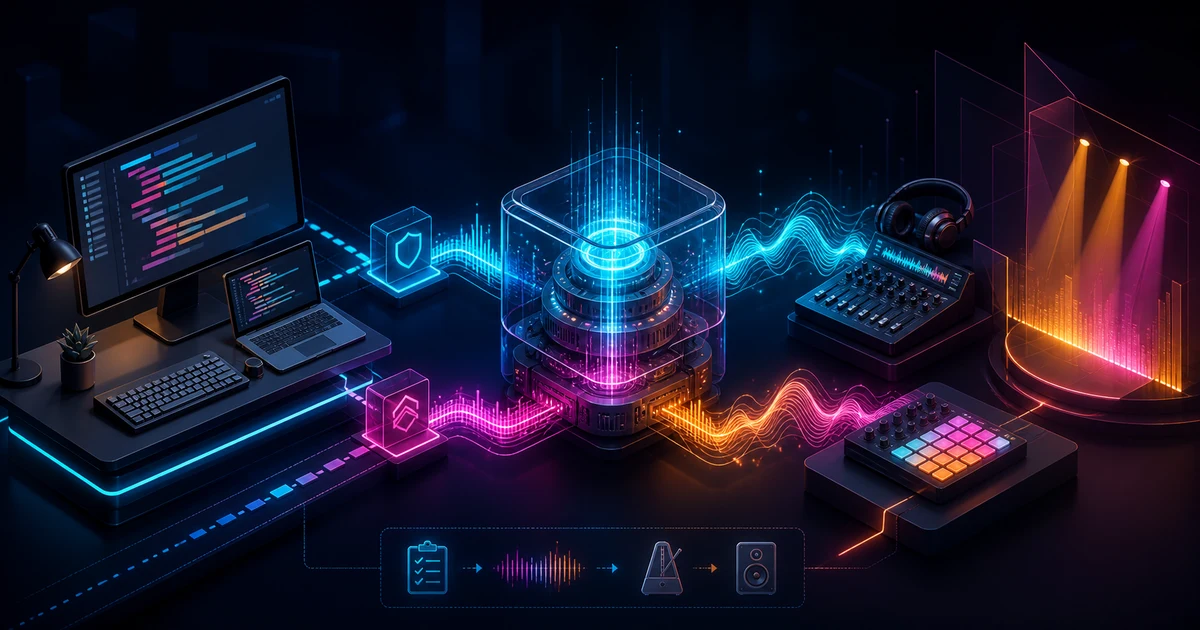
- SuperSonic renders audio and connects to devices, MIDI, game controllers, OSC-style control, and Ableton Link peers.
- Plain-text buffers and
.sonicpiSets store compositions locally; samples and recordings remain files that users can manage themselves.
This is a desktop musical instrument, not a hosted service. The basic workflow does not require an account, a cloud project, a database, or a container. Network boundaries appear when users deliberately connect peers or external control surfaces.
The improvements are practical, not cosmetic
For beginners, version 5 reduces several common sources of friction. Quickstart Cards offer runnable musical ideas. Code completion now includes inline documentation, pitch helpers, value sliders, and sample previews. Documentation examples can run inside the help pane. Errors are clearer, and code buffers grow to roughly 2,500 lines instead of failing at much smaller platform-dependent limits.
The accessibility work is unusually concrete for a creative tool. Release notes describe screen-reader navigation for documentation and Quickstart Cards, visible focus rings, operating-system contrast detection, reduced motion, spoken status updates, named buffers, and platform bridge tests. The repository also documents headless accessibility tests, native macOS and Windows bridge checks, and VoiceOver transcript validation. These are maintainer-reported engineering controls, not an independent accessibility certification, but they give schools a much better starting point than a generic “accessible” claim.
For performers, the important changes are at the audio and synchronization boundaries:
- Linux gets native PipeWire support and a 16-input/16-output patchbay device.
- Windows audio preferences become ASIO-aware.
link_audiocan receive live audio from compatible Ableton Link peers.use_bpm :midican follow an external MIDI clock.- Game controllers become event sources alongside MIDI devices.
- macOS and Windows can record the Sonic Pi window and main mix to video, or expose the window through Syphon and Spout.
The project reports a lower-latency main limiter—1.5 milliseconds rather than 20 milliseconds—especially relevant to live_audio. OpenSourceChoice did not reproduce that number. Treat it as a release claim to verify with the actual interface, sample rate, buffer size, and performance set.
What Sonic Pi still does not replace
Version 5 broadens Sonic Pi without turning it into every music tool at once.
It is not a conventional digital audio workstation with a linear arrangement timeline, non-destructive multitrack editing, plugin marketplace, mastering workflow, or collaborative cloud session. It is not a browser application. It does not provide classroom device management, identity, assignment submission, or centralized policy. It is not a headless audio service with a supported server API and uptime contract.
Those boundaries are healthy. Sonic Pi's value is the short feedback loop between readable code and audible result. A school may still need its learning platform and device-management system. A performer may still route Sonic Pi into Ableton Live, Bitwig, Reaper, OBS, or another production environment. A studio that mainly edits recorded audio should evaluate a DAW first.
The breaking changes make blind upgrades risky
Most Sonic Pi code should remain recognizable, but the audio result is part of the program. Version 5 changes that result in several ways:
set_volume!now accepts0to1, not0to5.- Volume and drive are separate controls around a new limiter.
- The internal mixer and effects order changed.
- The maintainers explicitly warn that an existing piece may sound different.
- Version 5 uses separate configuration files, so version 4 preferences do not migrate.
A successful launch and a syntax-clean set are therefore insufficient acceptance tests. Record the version 4 reference output, then compare peak level, loudness, dynamics, distortion, effects balance, timing, and controller behavior under version 5. A performer should rehearse the exact set through the exact interface and venue routing. A teacher should run every lesson example, not only the first tutorial card.
The separate settings directory is an advantage: version 4 and version 5 can remain available side by side, and version 5 does not overwrite the older preferences. Preserve the composition files and a known-good installer as well; settings separation is not a complete backup.
Platform and package reality
The official distribution is direct desktop software, not a registry package or container image.
| Platform | Official version-5 artifact | Current requirement or caveat |
|---|---|---|
| Windows x64 | Signed MSI | Windows 10 or 11 |
| Windows Arm64 | Signed MSI | Windows 11 |
| macOS Apple Silicon | DMG | macOS 13 Ventura or later |
| macOS Intel | DMG | macOS 13 Ventura or later |
| Linux x64 | AppImage | Official artifact, but upstream build docs still say Linux cannot be guaranteed across distributions and hardware |
| Linux Arm64 | AppImage | Marketed for Arm devices including Raspberry Pi; validate the exact board, OS, and audio path |
| Linux x86 | AppImage | A new tested 32-bit build is listed in the release |
The release page publishes SHA-256 checksums for each download. Schools and studios should archive the selected installers and verify those hashes before internal distribution. Do not substitute the stale community Chocolatey package, which still advertises version 3.1.0. A commenter also reported that the community Flatpak lacked some documentation; the maintainer clarified that AppImage is the officially supported version-5 Linux package.
Containers are not the missing deployment path here. Sonic Pi is a hardware-facing interactive desktop app. Passing audio, MIDI, game controllers, low-latency scheduling, a GUI, and accessibility bridges through a container usually adds complexity without solving classroom or performance management. Use the native packages unless a separately justified kiosk design has been tested end to end.
Early issue reports deserve a staging window
The repository is active and the open issue count is modest, but version 5 was only four days old at the time of this analysis. Current reports include:
- Issue #3560, where starting code immediately after the interface loads can produce timing errors on the reporter's setup.
- Issue #3561, where one user reported a startup failure on macOS 26.6.
- Issue #3558, where Quickstart live loops do not always stop when toggled off.
- Issue #3553, an open multichannel-output regression report from the release-candidate cycle.
These are community reports, not failures reproduced by OpenSourceChoice, and they do not show that every installation is affected. They do show why a stable label should not replace local validation. Timing at startup, multichannel routing, new operating systems, and beginner-facing controls are exactly the areas that matter in a classroom or on stage.
Privacy and security boundaries
Sonic Pi's default data boundary is favorable: code, samples, Sets, and output live on the user's machine, and the official workflow does not require a hosted account. That is a meaningful advantage for schools, workshops, and artists who do not want compositions or recordings sent to a SaaS provider.
The boundary expands with features:
- audio input gives the app access to a microphone or interface;
- Link Audio exchanges streams with peers on the local network;
- MIDI, OSC-style messages, and game controllers add external event sources;
- Syphon and Spout expose the application image to other local software;
- loaded files and
.sonicpiSets become executable creative code.
Treat third-party compositions as code, not passive documents. Open unfamiliar files under a standard user account on a non-sensitive machine, disable network features that are not needed, and do not run classroom sessions from administrator accounts. Separate student data from the music workstation profile and apply normal operating-system patching.
The project currently has no SECURITY.md reporting policy and no published GitHub security advisories. That does not prove the absence of vulnerabilities. For an institutional rollout, the missing private-reporting path and response expectations are governance gaps. Keep the application off unnecessary network segments and decide who monitors upstream issues and bundled dependency updates.
License, commercial use, and portability
The license is more layered than the “MIT” badge many readers will expect.
The main Sonic Pi source under app/ is MIT-licensed. Bundled samples are CC0, while the tutorial, documentation, and examples are CC BY-SA 4.0. The binary distribution also includes GPL software: the project's license file says GUI distributors must comply with GPL terms, and SuperSonic contains a GPL-licensed SuperCollider-derived engine core.
For ordinary users making music, there is no software-license fee and the bundled samples have a permissive public-domain dedication. For organizations redistributing a customized application, embedding the engine, or shipping the GUI in commercial hardware, “the main code is MIT” is not a complete legal answer. Review the complete component inventory and corresponding-source obligations for the exact build.
Data portability is comparatively good. Sets are plain text, so they can be diffed, backed up, and version-controlled. Samples and recorded audio are ordinary files. The lock-in sits in Sonic Pi's language, synth names, effects, timing semantics, and mixer behavior. Preserve code, external samples, installer hashes, configuration notes, MIDI maps, and rendered reference audio. Do not make a live performance recoverable only by reinstalling “latest.”
Maturity and maintainer concentration
Sonic Pi is not a weekend project. The repository dates to 2013, has more than 12,000 commits, documents a core team and many contributors, and shipped stable releases long before version 5. The v5 cycle also included accessibility testing, multiple release candidates, platform installers, checksums, and upstream packaging work.
The release evidence also shows concentration. The latest release commits and public announcement were driven primarily by Sam Aaron, and the project's funding page centers on sponsorship and Patreon support. That does not justify assigning a numerical bus factor, but institutions should identify who owns release signing, package hosting, security response, and maintenance continuity. Free software removes license fees; it does not create an enterprise SLA.
Alternatives to evaluate in parallel
The best alternative depends on which part of Sonic Pi you value.
| Option | Choose it when | Main trade-off |
|---|---|---|
| Strudel | Browser access and zero-install workshops matter more than a native integrated instrument | Web-audio and browser constraints; active source development moved from GitHub to Codeberg |
| TidalCycles | Pattern transformation and algorave workflows are the main goal | Steeper Haskell and SuperCollider setup; less beginner-oriented interface |
| SuperCollider | Deep synthesis, language flexibility, and audio-engine control matter most | Much higher learning and operational complexity |
| LMMS | A conventional arrangement, piano roll, and production workflow is required | It is a DAW rather than a code-first live instrument |
For a school, compare Sonic Pi with Strudel on the actual device fleet: native audio reliability and accessibility versus browser deployment. For a performer, compare Sonic Pi with TidalCycles and SuperCollider around musical language, routing, recovery time, and the amount of infrastructure you want to operate.
A measurable adoption plan
Use a small, reversible pilot rather than a fleet-wide installer push.
1. Freeze the candidate
Archive the exact installer and SHA-256 checksum for every platform. Record operating-system build, audio driver, interface firmware, controller model, and Sonic Pi version. Keep version 4 installers and configurations available.
2. Build a representative test library
Include beginner tutorial cards, the longest classroom lesson, a version-4 composition using set_volume!, custom samples, live audio, MIDI input, external clock, multichannel routing, and one full performance set. Add screen-reader and keyboard-only flows if those are required by any learner.
3. Define acceptance thresholds
Require 100% successful starts across at least 20 cold launches per device class, no unexplained audio dropouts during a two-hour rehearsal, correct device recovery after unplugging and reconnecting, and at least 30% CPU headroom at the busiest section. Set an explicit maximum acceptable launch-to-first-sound time.
4. Compare sound, not only code
Record version 4 and version 5 through the same signal path. Compare peaks, integrated loudness, dynamics, effects balance, and transitions. Obtain a human musical sign-off for every piece that will be taught or performed.
5. Test failure and rollback
Disconnect the interface, switch sample rates, remove the controller, interrupt Link Audio, and reboot without network access. Confirm that the operator can restore the known-good version and set in under ten minutes without losing work.
6. Expand by cohort
Deploy to one workshop or a small performer group first. Monitor upstream issues for at least one maintenance window. Expand only after the pilot meets the thresholds and support staff can reproduce installation, backup, and rollback.
OpenSourceChoice conclusion
Sonic Pi 5 is a substantial open-source release with a clear reason to exist. It makes the first minutes friendlier, takes accessibility seriously, and removes audio-routing constraints that limited professional use. The long release history, local-first model, plain-text projects, and official cross-platform artifacts make it a credible tool rather than a trend-only demo.
It is also a new audio stack with breaking mixer behavior and first-week issue reports. That makes it a good candidate for immediate evaluation, not an automatic production replacement.
New users can reasonably start with version 5. Small workshops should pilot it now. Managed classrooms should validate lessons, accessibility, installers, and rollback before the next teaching cycle. Performers should keep version 4, rehearse the exact set through the exact hardware, and accept version 5 only when both the measurements and the music agree. Test Strudel in parallel for browser-first teaching and SuperCollider when deeper synthesis control matters more than Sonic Pi's integrated experience.
Sources
Sources were accessed on August 11, 2026 unless another date is listed.
- Sonic Pi 5.0.0 release notes — Sonic Pi maintainers; released August 7, 2026; features, breaking changes, platform artifacts, and checksums.
- Sonic Pi repository and current documentation — Sonic Pi maintainers; architecture, project scope, contribution history, and current activity.
- Official Sonic Pi downloads — Sonic Pi; version 5 platform requirements and direct artifacts observed August 11, 2026.
- Sonic Pi license inventory — Sonic Pi maintainers; MIT, GPL, CC0, CC BY-SA, and bundled-component terms for version 5.
- Sonic Pi security overview — GitHub; no detected security policy or published advisories as observed August 11, 2026.
- Linux build documentation — Sonic Pi maintainers; dependencies, source build, and Linux support caveat for version 5.
- Qt GUI accessibility testing notes — Sonic Pi maintainers; test layers and platform accessibility bridges.
- Issue #3560: startup timing report, issue #3561: macOS startup report, issue #3558: Quickstart loop report, and issue #3553: multichannel report — Sonic Pi issue tracker; current user reports, not independently reproduced by OpenSourceChoice.
- Sonic Pi v5 Hacker News discussion — Hacker News; August 11, 2026; interest and user-experience signal only, not primary technical evidence.
- Strudel and current Strudel source — Strudel project; browser live-coding alternative and current source location.
- TidalCycles, SuperCollider, and LMMS — official project repositories; current alternative scope and maintenance checked for the comparison.
Build a stack for this use case.
Answer nine practical questions and compare three transparent architectures with costs, free limits, lock-in, and migration paths.
Build my stack