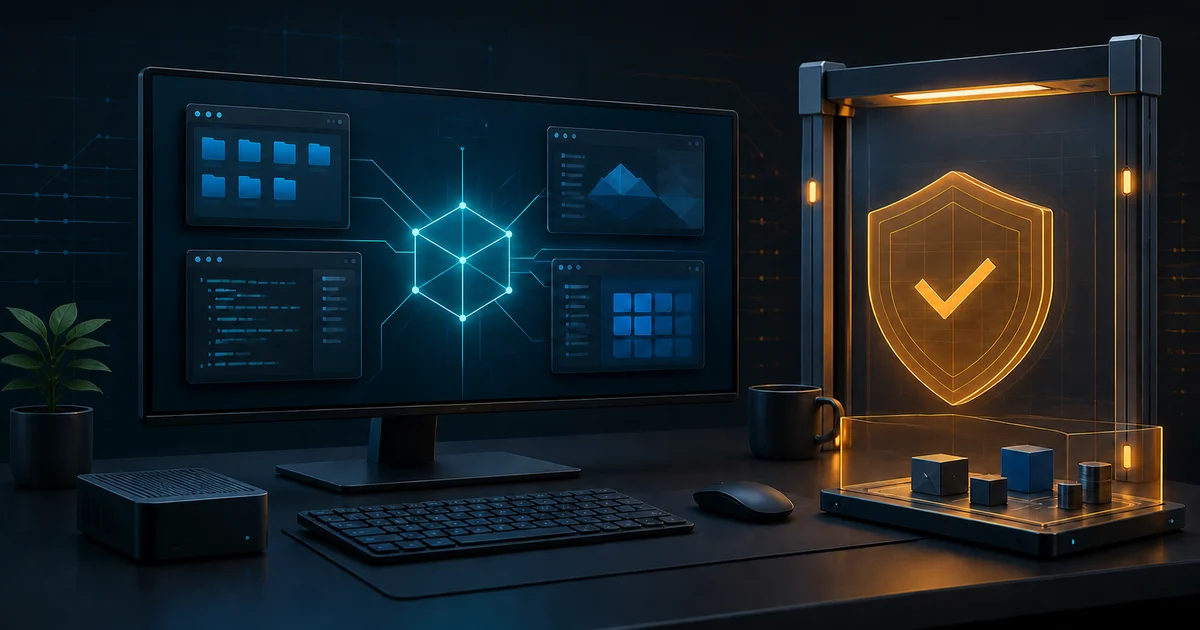

KIO Snapshot 1.0 finally puts Btrfs file history where many KDE users expect it: inside the normal file workflow. A user can right-click a file in Dolphin, browse versions preserved by existing snapshots, open or compare them, and copy the wanted version back to a normal folder.
The practical verdict is positive but narrow. Install KIO Snapshot when a KDE workstation already has a deliberate Btrfs snapshot policy. Do not adopt it as the snapshot policy, the retention policy, or the backup. It creates none of those things. Its value is reducing recovery friction; its main risk is making teams believe easier access also means safer data.
This is a researched technical analysis of version 1.0.0 and the upstream, package, security, and community state observed on August 22, 2026. OpenSourceChoice inspected the tagged source and current distribution metadata. We did not run KIO Snapshot on a Linux workstation, perform a destructive restore, or independently audit the complete KDE and Btrfs dependency stack.
Executive verdict
| Question | OpenSourceChoice assessment |
|---|---|
| Best fit | KDE users on Btrfs who already create accessible, tested snapshots of the files they need to recover |
| Poor fit | Ext4 or ZFS systems, mixed desktop fleets, machines without a snapshot orchestrator, or anyone seeking off-device backup |
| Real adoption cost | Subvolume design, Snapper permissions, read-only validation, retention and space monitoring, restore drills, and a separate backup target |
| Main risk | Local snapshots share the same filesystem and can expose deleted historical data to processes running as the allowed user |
| Parallel alternative | Use Snapper or Btrfs Assistant for lifecycle management and Kup, Restic, Borg, or another tested tool for off-device backup |
| Production gate | Restore representative files by checksum, prove snapshots cannot be modified, test user separation, and recover after simulated disk loss |
Why this matters now
KDE published the first stable source release, KIO Snapshot 1.0.0, on August 20. The upstream tag and detached source signature are current, the matching master pipeline passed, and Arch Linux placed 1.0.0 in its official extra repository the same day. Fedora Rawhide also has 1.0.0, while Fedora 44 listed it in updates-testing when checked. This is a real release with early distribution integration, not only a prototype announcement.
Interest is independent of the release machinery. The developer's August 20 explanation reached active discussions on both r/kde and Lobsters, with questions about Snapper permissions, Timeshift layouts, ZFS, and whether the component replaces snapshot managers. An EndeavourOS discussion then exposed exactly the adoption confusion this article addresses: users expected a package to create or manage snapshots, while KIO Snapshot only browses snapshots that already exist and are accessible.
GitHub Trending, Hacker News, XDA, Product Hunt, and indexed X searches did not show a comparable KIO Snapshot-specific signal during this review. The subject is therefore timely because a stable KDE component is entering distributions and solving a validated desktop problem, not because it is viral everywhere.
What KIO Snapshot actually does
Version 1.0.0 has two user-facing parts:
- A KIO worker implements a
snapshot://protocol. KDE applications can use that virtual location to list snapshots of a Btrfs subvolume or versions of one file across those snapshots. - A file-item action plugin adds View snapshots… for files and Browse snapshots… for directories when the source finds accessible history.
The file view includes the current file and distinct historical versions. The directory view exposes browsable snapshot trees. Because these are ordinary KIO locations, users can open a version, copy it to another directory, inspect metadata, or send multiple versions to a comparison tool. There is no special proprietary archive format and no KIO Snapshot cloud service.
What it does not do is just as important. KIO Snapshot does not:
- create or schedule snapshots;
- choose which subvolumes belong in a snapshot;
- prune old snapshots or enforce a storage budget;
- perform a full subvolume rollback;
- replicate data to another disk or host;
- verify backup recoverability;
- provide Ext4, XFS, ZFS, LVM, or remote-object-storage history;
- turn a snapshot into an immutable backup.
If the right-click action is missing, the likely problem is below the UI: the selected path is not in a Btrfs subvolume with detectable snapshots, the snapshots are not mounted or readable, or the user's permissions do not expose them.
Architecture: a local, rootless view over Btrfs
The implementation is small and direct. Tagged source declares C++20, Qt 6.8 or newer, KDE Frameworks 6.23 or newer, KIO, Solid, and libbtrfsutil from btrfs-progs. libbtrfsutil enumerates subvolumes and matches snapshots through parent UUIDs. Solid maps a path to the relevant mounted storage volume and filesystem root. The KIO worker translates the virtual URL into the corresponding local snapshot path.
The useful security decision is what is absent: the released design does not need a root daemon or a privileged DBus helper. The developer describes abandoning an earlier privileged-service design and deriving the necessary information from subvolumes already visible to the user. The tagged source matches that description; it queries local paths and exposes a KIO worker inside the user's session.
This makes the privacy boundary easy to describe. KIO Snapshot has no account, telemetry endpoint, synchronization service, model API, or network client in the inspected source. File names, snapshot paths, and historical content remain on the workstation. Distribution package retrieval and normal system updates are separate network paths owned by the operating system.
Local-only does not mean low-risk. The component runs with the user's access and makes that access convenient. A compromised desktop process with the same identity may be able to read the same historical files. A password, token, private draft, or personal record deleted from the live tree can remain readable until the retaining snapshot is removed. Treat snapshot retention as data retention, not only disk housekeeping.
The permission change is a real security decision
The upstream README gives Snapper users two requirements: add the user to ALLOW_USERS for the relevant Snapper configuration and enable SYNC_ACL=yes. Those settings make root-owned snapshot directories traversable by the allowed user so a rootless KDE component can browse them.
That is reasonable on a single-user laptop, but it should not be copied blindly to shared systems. Before enabling it, answer four questions:
- Which subvolume and snapshot set becomes visible?
- Does each user see only their own historical home data?
- Can sandboxed or background applications running as that user read the history?
- How quickly are sensitive deleted files removed from every retained snapshot?
KIO Snapshot does not define whether the underlying snapshots are read-only. Btrfs itself creates snapshots as read-write by default, while many orchestrated backup workflows deliberately mark them read-only. The KIO file-version view advertises historical entries as read-only, but the full tree ultimately resolves to real filesystem paths. The safe deployment rule is therefore independent of the UI: verify the snapshot property and prevent historical copies from being modified in place. Restore by copying to a new path, validate the result, and only then replace the live file.
This read-only requirement is an OpenSourceChoice operational inference from the tagged forwarding worker and Btrfs snapshot semantics, not a maintainer claim that KIO Snapshot enforces immutability.
A snapshot is still not a backup
The Btrfs documentation is explicit: a snapshot and its source initially share data blocks, so damage to the filesystem or device can damage both. Theft, controller failure, destructive administrative commands, filesystem corruption, and site loss can remove the live data and every local snapshot together.
Snapshots are excellent for fast local recovery from an accidental edit or deletion. They are also useful as consistent source points for replication. They do not by themselves satisfy the independent-copy part of a backup strategy.
There are two more traps:
- Nested subvolumes are snapshot boundaries. A home snapshot does not recursively capture a nested VM, container, database, or separately managed data subvolume. Empty-looking placeholders can hide the omission.
- Snapshots share the filesystem's storage pool. Changed blocks accumulate, and deletion cleanup can take time. Retention without quotas or monitoring can consume the free space needed by the live system.
The minimum complementary design is an automated off-device backup with versioned retention and a tested restore. Btrfs send/receive can replicate read-only snapshots to another Btrfs filesystem. Kup, Restic, or Borg can provide a different backup workflow. The brand matters less than proving that loss of the workstation does not remove the recovery copy.
Packaging is current but uneven
Arch Linux users have the simplest supported evaluation path: kio-snapshot 1.0.0 is in the official extra repository and depends on the expected KDE and Btrfs libraries. Fedora Rawhide also lists 1.0.0; Fedora 44 had the build in updates-testing on August 22. KDE neon's unstable metadata still exposed a pre-release 0.0.1 snapshot from before the stable tag, and the developer said KDE Linux would ship the complete Snapper integration soon rather than claiming it already did.
The upstream release is a signed 26 KB source archive. Building it requires a recent Qt and KDE Frameworks stack plus development headers for libbtrfsutil; that is a poor reason to replace core desktop libraries on a stable distribution. Prefer the distribution package, confirm that its version is 1.0.0 or newer, and wait when the required framework versions are not available through the normal supported channel.
There is no meaningful container installation path. This is a desktop file-manager integration that needs the user's mounted Btrfs filesystem and KIO session. A container would add permission and namespace complexity without solving the core problem.
Maturity, maintenance, and security posture
The system/kio-snapshot repository was created in June 2026. It had 25 commits in the 30 days before this review, and the release commit's full Linux/KDE pipeline passed. Tests create a temporary Btrfs filesystem image, populate subvolumes and snapshots, and exercise URL parsing plus file and directory listings. CI also runs KDE's REUSE, JSON, Linux Qt 6, static-analysis, and clazy checks.
That is a credible baseline for a small integration, but 1.0.0 is still its first stable release. The public Bugzilla product had one open unconfirmed issue concerning AppStream XML validation. No KIO Snapshot advisory appeared in KDE's security-advisory list when checked on August 22; that is a dated observation, not proof that no vulnerability exists.
Implementation ownership is concentrated. GitLab attributed 82 of 84 repository commits to Bharadwaj Raju, with one commit each from two other contributors. KDE's release, CI, translation, bug-tracking, and distribution infrastructure reduce project-isolation risk, but they do not remove the dependency on the primary implementer for design knowledge. Fleet adoption should therefore pin a package version, keep a direct filesystem recovery procedure, and avoid making the KIO menu the only documented restore path.
KDE provides a central private security-reporting process at security@kde.org and publishes advisories, but it has no bug-bounty program. The project license is LGPL-2.0-or-later. Commercial use is allowed; organizations redistributing modified binaries must review the weak-copyleft obligations for the library and preserve the applicable notices and source availability. There is no service fee or vendor lock-in. The lock-in is architectural: Btrfs subvolume layout, Snapper policy, KDE integration, and operator knowledge.
Who should adopt it
KIO Snapshot 1.0 is a good fit for:
- an Arch or current KDE workstation already using Btrfs and Snapper;
- a single-user laptop where fast recovery from accidental edits has clear value;
- a managed Linux desktop fleet with documented home-subvolume layout and off-device backups;
- technical users who want file-level recovery without opening a separate snapshot administration tool;
- distributions prepared to configure safe per-user snapshot access out of the box.
It is a poor fit for:
- a workstation formatted with Ext4, XFS, or ZFS;
- a system where
/homeis not included in any snapshot policy; - a shared machine without tested separation between users' historical data;
- a regulated environment that has not mapped snapshot retention to deletion obligations;
- an operator expecting Time Machine-style scheduling, capacity management, or remote backup from one package;
- a stable distribution that would require an unsupported KDE Frameworks upgrade to compile it.
Alternatives to evaluate in parallel
Snapper: lifecycle management
Snapper creates, compares, and deletes snapshots and can run timeline and cleanup policies. KIO Snapshot consumes the results; it does not replace Snapper. Evaluate the pair when the desired experience is frequent Btrfs snapshots plus file recovery in Dolphin.
Btrfs Assistant: an administrative GUI
Btrfs Assistant is better suited to inspecting configurations, managing snapshots, and handling broader Btrfs administration. It is more operational than KIO Snapshot's contextual file view. Use it when the person recovering data is also responsible for snapshot policy.
Kup, Restic, or Borg: the independent recovery layer
These tools solve a different and necessary problem: producing restorable data outside the live filesystem. Kup integrates with KDE and can use versioned backup backends; Restic and Borg support encrypted repository workflows. Evaluate at least one off-device path beside KIO Snapshot. A quick right-click restore and a disaster-recovery backup are complementary, not competing products.
A measurable seven-day evaluation
1. Inventory the real storage layout
Record the filesystem, mount points, Btrfs subvolumes, nested subvolumes, Snapper configurations, snapshot locations, and current retention. Select a non-critical user and a folder containing test documents, a directory tree, a large file, a symlink, and a deliberately nested subvolume.
2. Establish independent recovery first
Complete one off-device backup and restore a test file from it before changing snapshot permissions. This prevents the pilot from using the new UI as evidence that disaster recovery exists.
3. Create known history
Create at least three scheduled snapshots around controlled edits and deletions. Record hashes for every version. Verify that each historical snapshot is read-only and that the nested-subvolume result matches the documented layout.
4. Enable the narrowest access
Configure ALLOW_USERS and SYNC_ACL only for the test user's relevant Snapper configuration. Confirm that a second local user cannot list or open the history. Check whether sandboxed applications in the real desktop session can reach snapshot paths under the user's authority.
5. Test recovery, not only browsing
Use Dolphin to find and copy ten historical files into a neutral recovery directory. Require all hashes to match. Test a deleted file, a renamed directory, a mounted secondary Btrfs volume, and a snapshot pruned while the view is open. Do not overwrite the live file until the recovered copy passes comparison.
6. Exercise storage and failure conditions
Measure snapshot growth over the week, trigger the retention cleanup in a controlled window, and alert before the filesystem reaches the team's free-space floor. Unmount and reconnect a secondary volume. Confirm that a missing snapshot produces a clear failure rather than a misleading empty recovery result.
7. Set accept/reject gates
Adopt only if all ten test files recover with matching hashes, a normal file can be found in under two minutes, snapshots remain unmodified, cross-user access is denied, snapshot growth stays within budget, and an off-device restore succeeds after the local test copy is made unavailable. Defer if any required data lives behind an unsnapshotted nested subvolume or if the supported distribution package is not yet available.
Final assessment
KIO Snapshot 1.0 turns a capable filesystem feature into an understandable desktop action. That is meaningful open-source infrastructure work: it is local, compact, rootless, integrated with standard KDE applications, and already entering major distribution channels.
Its success should be judged by fewer recovery mistakes, not by how much backup tooling it appears to replace. The component cannot choose a correct subvolume layout, control retention, protect deleted secrets, make a writable snapshot immutable, or survive loss of the disk. Those remain operator responsibilities.
Adopt KIO Snapshot as the recovery interface for an existing Btrfs design. Keep Snapper or another orchestrator beneath it, a tested off-device backup beside it, and a command-line recovery procedure behind it. If those layers are missing, the right next step is not the Dolphin plugin; it is building the recovery system the plugin expects to find.
Sources and verification notes
Project, package, repository, security, and community state were checked on August 22, 2026. Package channels and issue state can change after publication. Community counts are discovery signals, not quality scores.
Primary and official sources
- KIO Snapshot 1.0.0 source release — KDE, August 20, 2026; signed source archive and stable release timestamp.
- KIO Snapshot v1.0.0 tag and repository — KDE Invent; current release, commit activity, contributors, and maintenance state.
- KIO Snapshot README at v1.0.0 — component scope and Snapper
ALLOW_USERS/SYNC_ACLrequirements. - Build definition at v1.0.0, Btrfs query implementation, KIO worker, and context-menu plugin — architecture, dependencies, local path resolution, and user-facing actions.
- Release commit pipeline and test harness — KDE CI and Btrfs-backed integration tests for the exact release commit.
- KIO Snapshot Bugzilla product — current public bug state; checked August 22.
- Arch Linux kio-snapshot package — official 1.0.0 package, dependencies, and August 20 build metadata.
- Fedora kio-snapshot package — Rawhide and Fedora 44 testing channels observed August 22.
- KDE neon unstable AppStream report — pre-release package metadata observed before stable-channel catch-up.
- KDE security advisories and reporting — central disclosure process, advisory list, and absence of a bug-bounty program; checked August 22.
- Btrfs subvolume and snapshot documentation — upstream Btrfs project; snapshot semantics, nested-subvolume boundaries, shared storage, and the explicit snapshot-is-not-backup warning.
- Btrfs send documentation — upstream replication requirements for read-only snapshots.
- Snapper configuration reference and Snapper permissions notes — upstream access and ACL behavior.
- Btrfs Snapshot Integration in KDE — Bharadwaj Raju, August 20, 2026; developer account of scope, rootless architecture, allied KDE work, KDE Linux plans, and release context.
- Btrfs Assistant, Kup, and Restic documentation — current alternative and complementary recovery layers.
Independent interest signals
- KIO Snapshot discussion in r/kde — August 20, 2026; independent questions about Snapper access, Timeshift, ZFS, and scope.
- KIO Snapshot discussion on Lobsters — August 21, 2026; independent filesystem and desktop-integration discussion.
- KIO Snapshot 1.0 discussion in the EndeavourOS forum — August 21, 2026; packaging and snapshot-manager expectations from early adopters.
Build a stack for this use case.
Answer nine practical questions and compare three transparent architectures with costs, free limits, lock-in, and migration paths.
Build my stack